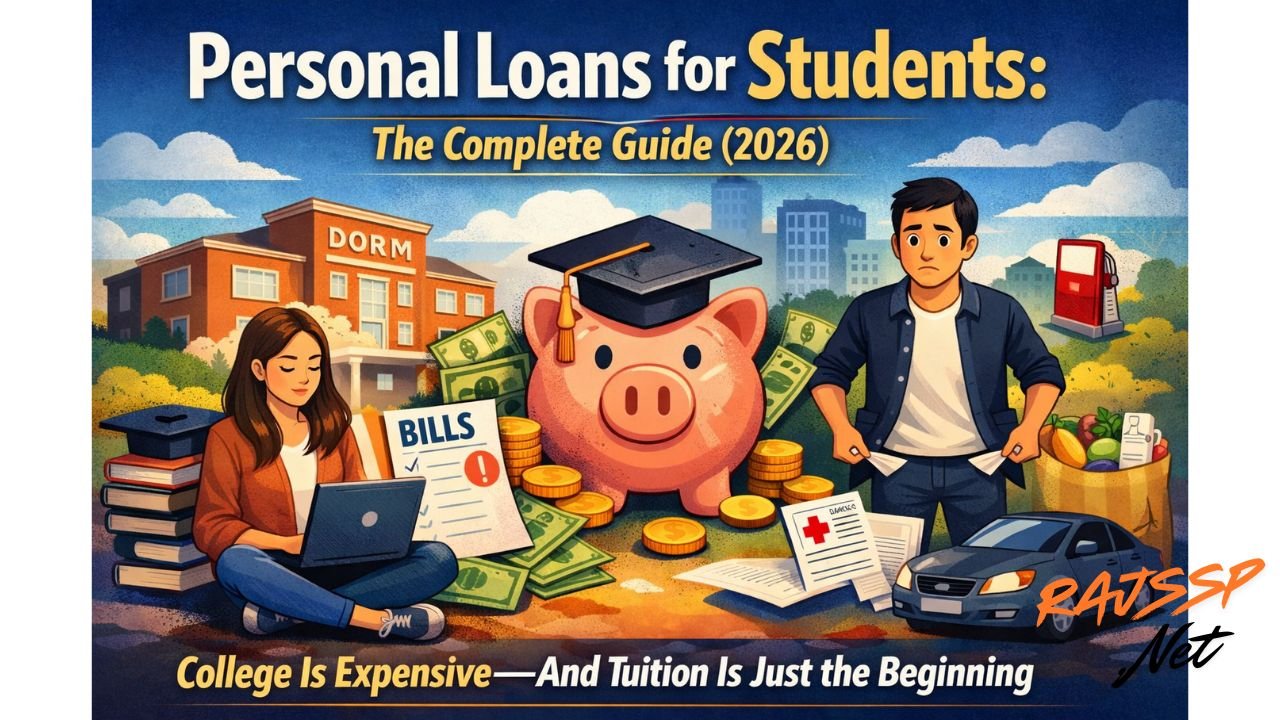
Personal Loans for Students: The Complete Guide (2026)
Introduction: College Is Expensive — And Tuition Is Just the Beginning
Every student knows the feeling. The semester starts, financial aid has been applied, tuition is paid, and then life happens. The rent is due, the laptop breaks down, groceries run low, and somehow, the textbooks cost more than expected. Tuition is rarely the only financial challenge students face. Living expenses, transportation, medical bills, and course materials all add up fast.
This is exactly where personal loans for students step in as a potential lifeline. Unlike scholarships or grants, personal loans provide flexible, fast cash that students can use for almost any expense — not just tuition. And unlike federal student loans, they don’t always come tied to enrollment requirements or academic conditions.
This guide is written for undergraduates, graduate students, and even part-time students who are navigating the messy middle ground between financial aid and real-world expenses. Whether someone is exploring personal loan apps for students, trying to find personal loans for students with no job, or simply looking for the best personal loan app for students available right now, this guide covers it all.
What Are Personal Loans for Students?
Definition and Key Characteristics
A personal loan is a type of installment loan where a borrower receives a lump sum of money upfront and repays it over a fixed period — typically ranging from 12 months to 60 months — with interest. Personal loans for students work the same way, but they are specifically marketed toward or accessible by college and university students.
These loans are generally:
- Unsecured — meaning no collateral is required
- Fixed amount — the borrower receives a set sum at once
- Repaid in monthly installments — with a fixed or variable interest rate
- Available from banks, credit unions, and online lenders
Secured vs. Unsecured Personal Loans
Most personal loans for students are unsecured, which means lenders don’t require students to put up assets like a car or property to qualify. This is important because most students don’t own major assets. However, unsecured loans typically come with higher interest rates since the lender is taking on more risk.
Secured personal loans require collateral but usually offer lower interest rates. They’re less common for students but may be an option through certain credit unions or banks.
Fixed vs. Variable Interest Rates
- Fixed-rate loans keep the same interest rate throughout the loan term. Monthly payments stay consistent, which makes budgeting easier.
- Variable-rate loans have interest rates that fluctuate based on market indexes. They may start lower but can increase over time.
For students managing tight budgets, a fixed-rate loan often makes more financial sense.
How They Differ from Federal and Private Student Loans
Here’s an important distinction that confuses many borrowers:
| Feature | Personal Loan | Federal Student Loan | Private Student Loan |
|---|---|---|---|
| Use of funds | Any purpose | Education-related | Education-related |
| Interest rates | Higher (typically) | Government-set (lower) | Varies by lender |
| Repayment flexibility | Limited | Income-driven options | Varies |
| Credit check required | Yes | No (most) | Yes |
| Enrollment required | No | Yes | Usually yes |
The biggest advantage of a personal loan is flexibility — it can cover rent, groceries, medical bills, or anything else beyond what traditional student loans will touch.
When Should a Student Consider a Personal Loan?
Not every financial situation calls for a personal loan, but there are several scenarios where it genuinely makes sense.
Covering Living Expenses
Rent, groceries, utilities, and transportation don’t pause during exam season. Students living off-campus often find that their financial aid doesn’t cover these costs fully. A personal loan can bridge that gap and keep the lights on — literally.
Emergency Expenses
Life doesn’t wait for convenient timing. A sudden medical bill, a car repair needed to get to campus, or an unexpected dental emergency can derail an entire semester. In these moments, an instant personal loan for students can be a real solution — many online lenders offer same-day or next-day funding.
Paying for Courses, Books, or Equipment
Some expenses fall outside what student aid will cover — specific software subscriptions, lab equipment, study materials, or professional certification prep courses. A personal loan can fund these without impacting enrollment or financial aid eligibility.
Bridging Gaps Between Semesters
There’s often a financial gap between when one semester’s aid runs out and when the next disbursement arrives. During summer breaks or between academic years, students may find themselves without income or aid. A short-term personal loan can serve as a bridge during these periods.
When NOT to Use a Personal Loan
It’s equally important to know when a personal loan is the wrong tool:
- Don’t use it to fund lifestyle spending that isn’t necessity-based
- Don’t use it if federal loan options haven’t been exhausted first — federal loans almost always offer better terms
- Don’t borrow more than can reasonably be repaid within the loan term
- Don’t use it as a substitute for building an emergency fund — loans come with interest; savings don’t
Types of Personal Loans Available to Students
Traditional Bank Personal Loans
Large national banks and regional banks offer personal loans to qualifying borrowers. Students with a solid credit history or an existing banking relationship may find this route accessible. However, banks tend to have stricter eligibility requirements, which can make it harder for students with limited credit history to qualify.
Credit Union Loans
Credit unions are member-owned nonprofit financial institutions that often offer lower interest rates and more flexible terms than traditional banks. Many college campuses have affiliated credit unions that offer student-friendly loan products. It’s worth checking whether the college or university has a partnership with a local credit union.
Online Lender Personal Loans
Online lenders have transformed the personal loan landscape. Many of the best personal loan apps for students are built on top of online lending platforms that use alternative data — like education level or earning potential — rather than just credit scores to determine eligibility. Lenders like Upstart, SoFi, and Earnest fall into this category. These platforms often feature:
- Fast application processes (sometimes under 5 minutes)
- Soft credit check pre-qualification
- Same-day or next-day funding in many cases
Co-Signed Personal Loans
For students who don’t meet credit or income requirements on their own, a co-signer — typically a parent or guardian — can dramatically improve approval odds and unlock better interest rates. The co-signer agrees to take responsibility for the loan if the primary borrower defaults, which reduces the lender’s risk.
Income Share Agreements (ISAs) — An Alternative
Income Share Agreements aren’t traditional loans, but they function as an alternative form of financing. Under an ISA, a student receives funding in exchange for agreeing to pay back a percentage of future income for a set period after graduation. These can be useful but require careful review of terms, as total repayment amounts can vary significantly depending on future earnings.
Eligibility Requirements
Minimum Age
In the United States, borrowers must be at least 18 years old to sign a legal contract, including a loan agreement. Some states set the minimum at 21. Students under 18 would need a legal guardian to apply on their behalf.
Credit Score Requirements
Most lenders look at credit scores when evaluating loan applications. Here’s a general breakdown:
- Excellent (720+): Best rates and approval odds
- Good (680–719): Good options available
- Fair (620–679): Limited options; higher rates
- Poor (Below 620): Difficult to qualify without a co-signer
Many students have little to no credit history, which is different from having bad credit. Lenders like Upstart use non-traditional data points (like GPA or degree type) to evaluate applicants with thin credit files.
Income Requirements
This is where personal loans for students with no job become tricky. Most lenders require proof of income. However, “income” doesn’t always mean a full-time job. Some lenders accept:
- Part-time employment income
- Freelance or gig work earnings
- Scholarship or stipend income
- Parental support documentation
Students with no income at all may need a co-signer or should explore alternatives like campus emergency funds before pursuing a personal loan.
The Role of a Co-Signer
A co-signer with a strong credit history and stable income can be the deciding factor in approval. Many students use a parent, older sibling, or relative as a co-signer. It’s a significant responsibility for the co-signer, so this arrangement should be discussed openly and honestly.
Does Enrollment Status Matter?
Unlike federal student loans, personal loans generally don’t require full-time enrollment. Even a part-time student, a student on a leave of absence, or someone attending a community college or vocational program can apply for a personal loan — as long as they meet the lender’s credit and income requirements.
How to Apply for a Personal Loan as a Student
Applying for a personal loan doesn’t have to be intimidating. Here’s a simple step-by-step breakdown:
Step 1: Check Your Credit Score
Before applying anywhere, students should check their credit score. Many banks and credit card apps offer free credit score monitoring. Knowing the score helps narrow down which lenders are realistic options.
Step 2: Research and Compare Lenders
Not all lenders are created equal. Students should compare:
- Interest rate ranges (APR)
- Loan amounts available
- Repayment terms
- Co-signer options
- Fees (origination, prepayment, late payment)
Personal loan apps for students often make this comparison easy, with side-by-side views built right into the app.
Step 3: Pre-Qualify with a Soft Credit Check
Most reputable lenders offer a pre-qualification step that uses a soft credit inquiry — meaning it won’t affect the credit score. This lets students see estimated rates and terms before committing to a formal application.
Step 4: Gather Required Documents
Typical documents needed include:
- Government-issued photo ID
- Proof of enrollment or student status
- Proof of income (pay stubs, bank statements, scholarship award letters)
- Social Security Number (SSN)
- Banking information for fund deposit
Step 5: Submit the Application
Once documents are ready, the formal application can be submitted. With online lenders and personal loan apps for students, this often takes less than 10 minutes.
Step 6: Review Loan Terms Before Accepting
Before signing anything, students should read the full loan agreement carefully, paying close attention to:
- Total repayment amount (not just monthly payment)
- APR vs. interest rate
- Any prepayment penalties
- What triggers a rate change (for variable loans)
Timeline: How Long Does Approval Take?
- Online lenders: Often within 24–48 hours; some offer instant personal loan for students approval with same-day funding
- Banks and credit unions: Typically 3–7 business days
- Co-signed applications: May take slightly longer due to additional verification
Interest Rates and Fees to Watch Out For
Typical APR Ranges
Personal loan APRs for students typically range from 8% to 36%, depending on creditworthiness, income, and lender. Students with strong credit and a co-signer may qualify for rates on the lower end.
Origination Fees
Some lenders charge an origination fee — typically 1% to 8% of the loan amount — which is deducted upfront before funds are disbursed. A $5,000 loan with a 5% origination fee means the student actually receives $4,750 but owes $5,000.
Prepayment Penalties
Some lenders charge a fee if the loan is paid off early. Students who expect to repay quickly should look for lenders with no prepayment penalties.
Late Payment Fees
Missing a payment can trigger a late fee and potentially damage the credit score. Students should understand exactly what constitutes a late payment under their loan terms.
How Credit Score Affects the Rate
Simply put — the better the credit score, the lower the interest rate. A student with a 740 credit score might receive an APR of 10%, while a student with a 600 score might face 28% or higher. This is why building or establishing credit early matters so much.
Top Lenders Offering Personal Loans for Students
Here’s a quick comparison of reputable lenders commonly considered among the best personal loan apps for students and traditional lenders:
| Lender | APR Range | Min. Credit Score | Co-signer Option | Loan Amounts |
|---|---|---|---|---|
| SoFi | 8.99%–29.49% | 680 | No | $5,000–$100,000 |
| Upstart | 7.40%–35.99% | 300 | No | $1,000–$50,000 |
| Earnest | 11.19%–24.99% | 665 | No | $1,000–$75,000 |
| Discover | 7.99%–24.99% | 660 | No | $2,500–$40,000 |
| LendingClub | 8.98%–35.99% | 600 | Yes | $1,000–$40,000 |
| Local Credit Unions | Varies (often lower) | Flexible | Yes | Varies |
Note: Rates and terms are subject to change. Always verify current offers directly with lenders.
What to Look for When Choosing a Lender
- Transparent fee structure — no hidden costs
- Flexible repayment terms — especially if income is uncertain
- Student-friendly underwriting — uses alternative data beyond credit score
- Fast funding — important for emergencies
- No prepayment penalty — freedom to pay off early
Pros and Cons of Personal Loans for Students
✅ Pros
Flexible Use of Funds Unlike federal loans that must go toward education-related costs, personal loans can cover anything — rent, food, travel, medical bills, or emergency repairs.
No Collateral Required Most personal loans for students are unsecured, so students don’t need to risk any assets.
Fast Disbursement Especially through online lenders and instant personal loan for students platforms, funds can arrive as quickly as the same day or next business day.
Builds Credit History Making consistent, on-time payments on a personal loan helps students build a positive credit history — a major financial asset after graduation.
❌ Cons
Higher Interest Rates vs. Federal Loans Federal student loans have government-set interest rates that are typically much lower than what personal loans offer. Students should exhaust federal aid options first.
No Income-Driven Repayment Options Federal loans offer repayment plans tied to income level. Personal loans don’t — the monthly payment is fixed regardless of financial situation.
Risk of Debt Accumulation Borrowing too much or from multiple sources can lead to a debt burden that’s hard to manage after graduation.
May Require a Co-signer Students with limited credit or income history may not qualify without a co-signer, which puts someone else’s financial health on the line.
Alternatives to Personal Loans for Students
Before taking on debt, it’s worth exploring every alternative available:
Federal Student Aid (FAFSA)
Filing the Free Application for Federal Student Aid (FAFSA) opens the door to federal grants, subsidized loans, and work-study programs — all with better terms than personal loans.
Scholarships and Grants
Free money doesn’t need to be repaid. Many scholarships are available beyond the freshman year — for academic performance, community involvement, or field of study.
Work-Study Programs
Federally funded work-study programs let students earn money through part-time jobs — often on campus — while maintaining enrollment.
Student Credit Cards
For smaller, recurring expenses, a student credit card with a low limit can serve as a manageable alternative — especially if paid off monthly to avoid interest.
Family Loans
Borrowing from family can be a practical solution if structured clearly, with a mutual understanding of repayment expectations.
Campus Emergency Funds
Many colleges and universities maintain emergency funds or hardship grants specifically for enrolled students facing sudden financial crises. These are often underutilized resources.
Gig Economy / Part-Time Work
Platforms like DoorDash, Fiverr, Uber, or TaskRabbit allow students to earn flexible income that can supplement financial aid without requiring a traditional job.
Tips for Responsible Borrowing
Taking on debt as a student is a serious decision. Here are five principles worth following:
1. Only Borrow What Is Truly Needed It’s tempting to accept the maximum loan offer, but borrowing only the necessary amount keeps repayment manageable and minimizes total interest paid.
2. Create a Repayment Plan Before Borrowing Students should run the numbers before signing. If the monthly payment is $200 and the expected post-graduation salary won’t support that — pause and reconsider.
3. Understand the Total Repayment Cost A $5,000 loan at 20% APR over 36 months doesn’t cost $5,000 — it costs significantly more. Using a loan calculator before borrowing is a smart habit.
4. Build an Emergency Fund to Reduce Future Loan Dependency Even setting aside $20–$50 per month into a savings account reduces the need to borrow for unexpected expenses in the future.
5. Monitor Credit Score Regularly Keeping an eye on credit score helps students catch errors, track improvement, and stay financially aware. Most personal loan apps for students include this feature for free.
Frequently Asked Questions (FAQs)
Can a student get a personal loan with no income?
Getting approved for personal loans for students with no job or no income is very difficult without a co-signer. Some lenders may accept alternative income sources like scholarships or family support, but most require some form of verified income. A co-signer is usually the most practical path in this situation.
What credit score is needed for a student personal loan?
Requirements vary by lender. Some online lenders — like Upstart — accept credit scores as low as 300, while traditional banks typically require 660 or above. For the best rates, a score of 700+ is ideal.
Can international students get personal loans?
This varies significantly. Most U.S. lenders require a Social Security Number (SSN) and U.S. residency. Some lenders, like Stilt, specialize in loans for visa holders and international students. International students should research lenders that specifically accommodate their status.
Is a personal loan better than a student loan?
Generally, no — not for education-related expenses. Federal student loans offer lower interest rates, income-driven repayment options, and potential forgiveness programs that personal loans simply don’t match. However, for non-education expenses like rent, groceries, or emergencies, a personal loan may be the only flexible option available.
Will applying for a personal loan hurt a credit score?
A soft inquiry (pre-qualification) does not affect credit scores. A hard inquiry (formal application) does cause a small, temporary dip — typically 5 points or less. Multiple hard inquiries within a short window can have a larger impact, so students should avoid applying to many lenders simultaneously.
Conclusion: Borrow Smart, Graduate Stronger
Navigating student finances isn’t easy, but understanding the tools available makes it significantly less stressful. Personal loans for students can be a practical, flexible resource when used wisely — especially for expenses that fall outside the scope of financial aid.
The key is to treat any loan as a last resort after exhausting grants, scholarships, work-study, and federal loan options. When a personal loan is the right move, choosing the right lender matters enormously. Whether it’s a traditional bank, a credit union, or one of the top personal loan apps for students, comparing rates, fees, and terms before committing can save hundreds or even thousands of dollars over the life of the loan.
Students with no income shouldn’t feel locked out — personal loans for students with no job are possible with the right co-signer and the right lender. And for those who need money fast, instant personal loan for students options through online platforms make same-day access to funds a real possibility.
The goal isn’t just to survive the semester — it’s to build healthy financial habits that last well beyond graduation.
Ready to explore options? Start by checking pre-qualification rates — it won’t affect the credit score and takes just a few minutes.
Also Read: Star Health Insurance IPO: Dates, Price, GMP, Subscription Status, Allotment & Review