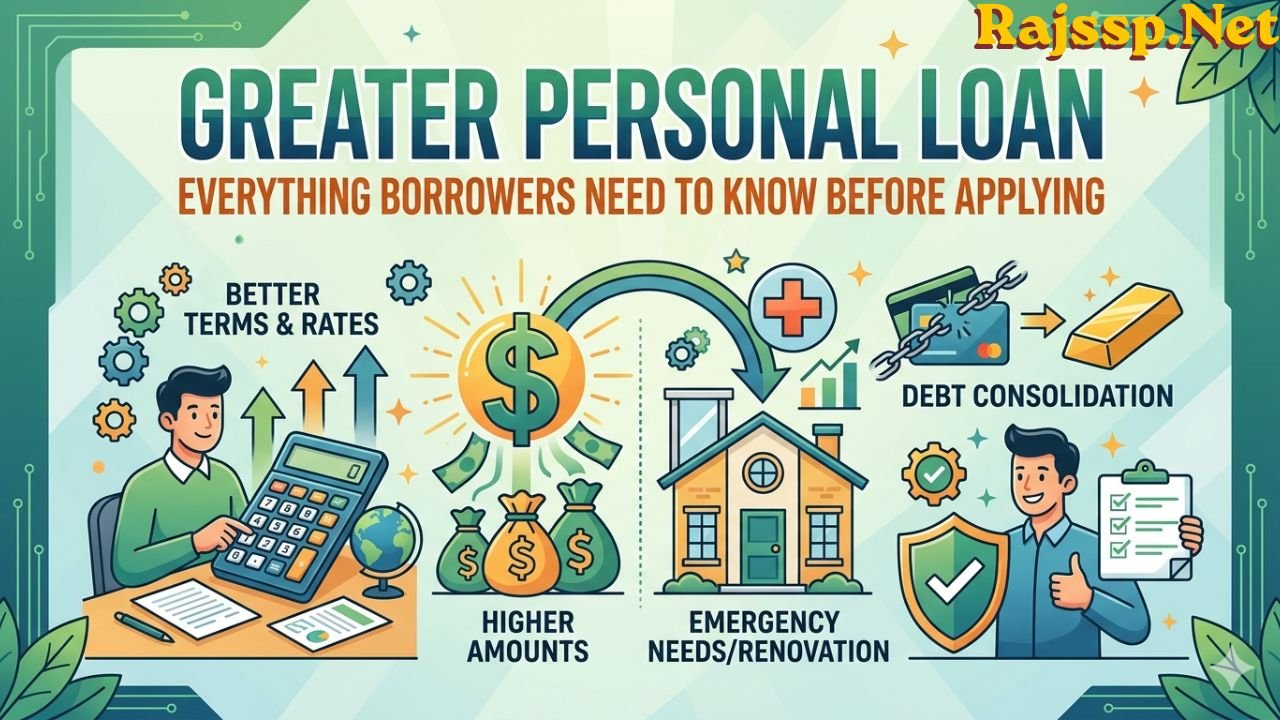
Greater Personal Loan Everything Borrowers Need to Know Before Applying
Introduction
Life has a way of throwing big financial moments at people — whether it’s a medical emergency, a long-overdue home renovation, or finally consolidating years of high-interest debt into one manageable payment. In situations like these, having access to the right borrowing option can make all the difference. That’s exactly where a greater personal loan comes in.
But what does “greater” actually mean in this context? It’s not just about borrowing more money. A greater personal loan refers to a loan that offers higher amounts, more favorable terms, lower interest rates, and better eligibility conditions — essentially, the best possible loan a borrower can access based on their financial profile.
This guide is written for people who want to stop settling for average loan offers and start understanding how to truly maximize their borrowing potential. Whether someone is exploring great personal loan companies for the first time or looking to upgrade their borrowing experience, this article breaks down everything they need to know — from qualifying tips to avoiding common mistakes.
What Is a Greater Personal Loan?
Definition and Scope
A greater personal loan is essentially an upgraded version of a standard personal loan. It typically comes with a higher borrowing limit, a lower annual percentage rate (APR), and longer repayment flexibility. These loans are generally available to borrowers who have demonstrated financial responsibility — meaning strong credit histories, stable income, and low debt-to-income (DTI) ratios.
While a basic personal loan might offer $5,000 to $15,000 with an average APR, a greater personal loan can offer $25,000 to $100,000 or more, with significantly better rates and terms.
How It Differs from a Standard Personal Loan
The difference between a standard and a greater personal loan often comes down to three factors: the borrower’s credit profile, the lender’s offerings, and the loan structure itself. Standard loans are more widely accessible but come with higher interest rates and lower ceilings. Great personal loans, on the other hand, reward borrowers who bring stronger financial profiles to the table.
Common Use Cases
People turn to greater personal loans for a wide range of reasons, including:
- Debt consolidation — Rolling multiple high-interest debts into a single, lower-rate loan
- Home renovation — Funding major upgrades without touching home equity
- Medical emergencies — Covering unexpected or large healthcare expenses
- Major life events — Weddings, adoptions, relocation costs, or education expenses
Key Features of a Greater Personal Loan
Higher Loan Amounts
One of the most significant advantages of a greater personal loan is access to larger sums. Borrowers with excellent credit can often access loans ranging from $25,000 to $100,000 or beyond, depending on the lender.
Lower Interest Rates (APR Comparison)
Interest rate is arguably the most important feature to examine. Borrowers with great credit — typically a FICO score of 720 or higher — can qualify for APRs as low as 6% to 10%, compared to the 18% to 30%+ rates that average-credit borrowers may encounter.
Longer Repayment Terms
Greater personal loans often come with repayment terms ranging from 3 to 7 years, giving borrowers more breathing room to manage their monthly payments without financial strain.
Flexible Usage (Unsecured vs. Secured)
Most greater personal loans are unsecured, meaning no collateral is required. However, secured options — backed by assets like savings accounts or vehicles — are also available and can unlock even better rates.
Minimal Fees
The best lenders offer loans with no prepayment penalties, low or zero origination fees, and transparent fee structures. These details matter greatly over the full life of a loan.
How to Qualify for a Greater Personal Loan
Credit Score Requirements
Credit score is the single biggest factor lenders look at. For personal loans for great credit, lenders typically expect a score of at least 700, with 720+ putting borrowers in the best position to access premium loan products.
| Credit Score Range | Loan Access Level |
|---|---|
| 750+ | Excellent — best rates and amounts |
| 720–749 | Very Good — highly competitive offers |
| 680–719 | Good — solid options available |
| Below 680 | Limited — fewer options, higher rates |
Income and Debt-to-Income (DTI) Ratio
Lenders want to see that a borrower earns enough to comfortably repay the loan. Most prefer a DTI ratio below 36%, though some lenders go up to 43%. This ratio compares monthly debt obligations to gross monthly income.
Employment Stability
Consistent employment history signals reliability to lenders. Most prefer at least two years of stable employment or self-employment income backed by solid tax records.
Existing Credit History and Profile
Beyond the credit score itself, lenders review the length of credit history, the mix of account types, and payment history. A clean track record with no recent late payments significantly strengthens an application.
Collateral (for Secured Options)
For borrowers who want to access higher amounts or lower rates, offering collateral can be a strategic move. Secured loans reduce lender risk, often translating into better terms for the borrower.
How to Get a Greater Personal Loan (Step-by-Step)
Getting a greater personal loan doesn’t have to be complicated. Here’s a clear, step-by-step path to follow:
Step 1: Check and Improve Your Credit Score Before applying anywhere, borrowers should pull their credit report from all three bureaus — Equifax, Experian, and TransUnion — and dispute any errors. Even a 20-point improvement can make a meaningful difference in the rate offered.
Step 2: Determine How Much You Need Borrowing more than necessary adds to the total interest paid over time. It’s smarter to calculate the exact amount needed and stick to it.
Step 3: Research and Compare Lenders Not all lenders offer the same products. Borrowers should compare offerings from banks, credit unions, and online lenders side by side.
Step 4: Gather Required Documents Typical documentation includes proof of income (pay stubs, tax returns), government-issued ID, proof of address, and bank statements.
Step 5: Submit Your Application Many lenders allow online applications that take less than 15 minutes. Pre-qualification tools let borrowers check estimated rates without affecting their credit score.
Step 6: Review Loan Offers Carefully Before signing anything, borrowers should read the full loan agreement — paying close attention to the APR, origination fees, repayment schedule, and any prepayment penalties.
Step 7: Accept and Receive Funds Once approved and accepted, funds are typically deposited directly into the borrower’s bank account within 1 to 5 business days.
Where to Find Greater Personal Loans
Traditional Banks and Credit Unions
Banks and credit unions remain a solid starting point, especially for existing customers. Credit unions, in particular, are known for offering competitive rates to members with great credit personal loans — sometimes at significantly lower APRs than commercial banks.
Online Lenders
Online lenders have transformed personal lending. Some of the most well-known names in this space include SoFi, LightStream, and Marcus by Goldman Sachs. These platforms often provide faster approvals, fully digital processes, and highly competitive rates for qualified borrowers.
Peer-to-Peer Lending Platforms
P2P platforms connect borrowers directly with individual investors. They can be a useful alternative, especially for those who may not fit the traditional banking mold but still have solid credit profiles.
Comparison Sites and Loan Marketplaces
Platforms like NerdWallet, Bankrate, and LendingTree allow borrowers to compare multiple lenders at once. These tools make it easy to see which great personal loan companies offer the most competitive products for a given borrower profile.
Pros and Cons of Each Option
| Lender Type | Pros | Cons |
|---|---|---|
| Banks | Trusted, relationship-based | Slower process, stricter criteria |
| Credit Unions | Lower rates, member-focused | Membership required |
| Online Lenders | Fast, convenient, competitive | Less personalized service |
| P2P Platforms | Flexible for varied profiles | Higher rates sometimes |
| Comparison Sites | Side-by-side convenience | May generate multiple inquiries |
Interest Rates & Terms: What to Expect
Fixed vs. Variable Interest Rates
Most great personal loans come with fixed interest rates, meaning the monthly payment stays the same throughout the loan term. Variable rates can start lower but carry the risk of rising over time.
How Credit Score Impacts APR
The relationship between credit score and APR is direct and significant. Borrowers in the excellent credit category can save thousands of dollars in interest over the life of a loan compared to those with average credit.
Loan Term Length and Monthly Payment Breakdown
Shorter terms mean higher monthly payments but less total interest paid. Longer terms lower the monthly payment but increase total cost. Borrowers should find the balance that fits their budget without stretching the loan longer than necessary.
Example Loan Scenarios
| Loan Amount | APR | Term | Monthly Payment | Total Interest Paid |
|---|---|---|---|---|
| $25,000 | 7.5% | 3 years | ~$777 | ~$2,972 |
| $25,000 | 7.5% | 5 years | ~$501 | ~$5,060 |
| $50,000 | 9.0% | 5 years | ~$1,038 | ~$12,280 |
| $50,000 | 9.0% | 7 years | ~$799 | ~$17,116 |
Tips to Maximize a Personal Loan
Borrow Only What You Need
It’s tempting to accept the maximum approved amount, but borrowing more than necessary means paying more in interest. Sticking to the actual need keeps costs controlled.
Improve Credit Before Applying
Even waiting 3 to 6 months to pay down existing balances and correct credit report errors can meaningfully improve the rate a borrower receives on personal loans for great credit.
Apply with a Co-Signer for Better Terms
A co-signer with excellent credit can help a borderline applicant qualify for a greater personal loan with better terms. This works best when the primary borrower has a solid income but a thinner credit file.
Shop Around and Pre-Qualify
Pre-qualification uses a soft credit pull, which doesn’t affect the credit score. Borrowers should use this tool with multiple lenders before committing to any one offer.
Choose the Shortest Repayment Term Affordable
Shorter terms save money in the long run. If a borrower can comfortably handle a slightly higher monthly payment, choosing a 3-year term over a 5-year term can result in significant savings.
Common Mistakes to Avoid
Overborrowing Beyond Repayment Ability
Taking out more than can realistically be repaid is one of the most common — and costly — mistakes borrowers make. It leads to missed payments, damaged credit, and potentially collections.
Ignoring the Total Cost of the Loan
Monthly payments are just one piece of the picture. Borrowers should always calculate the total cost of the loan — principal plus all interest and fees — before signing.
Applying to Too Many Lenders at Once
Each hard credit inquiry can temporarily lower a credit score. Submitting multiple full applications within a short period can stack up inquiries and hurt the score needed to qualify for a great personal loan.
Skipping the Fine Print on Fees and Penalties
Some lenders bury fees in the fine print — origination fees, late payment fees, or prepayment penalties. Reading the full loan agreement before signing protects borrowers from unwelcome surprises.
Using Loans for Non-Essential Spending
A greater personal loan is a financial tool, not a shopping fund. Using it for discretionary or impulse spending creates debt without a meaningful return and can lead to long-term financial strain.
Greater Personal Loan vs. Alternatives
| Option | Best For | Pros | Cons |
|---|---|---|---|
| Greater Personal Loan | Large, fixed needs | Predictable payments, no collateral needed | Requires good to great credit |
| Credit Card | Small, short-term expenses | Convenient, widely accepted | High APR, revolving debt risk |
| Home Equity Loan | Homeowners with equity | Low rates, large amounts | Risk of losing home if defaulted |
| 401(k) Loan | Emergency funds | No credit check, fast access | Impacts retirement savings |
| Balance Transfer Card | Debt consolidation (small) | 0% intro APR offers | Transfer fees, limited window |
For borrowers with great credit, a greater personal loan almost always beats credit cards and 401(k) loans in terms of total cost and financial health impact.
FAQs About Greater Personal Loans
What credit score do I need for a large personal loan?
Most lenders offering greater personal loans prefer a credit score of 700 or higher. For the best rates and highest loan amounts, a score of 740 or above is ideal.
Can someone get a greater personal loan with bad credit?
It’s possible, but significantly more difficult. Lenders may approve smaller amounts with higher rates. A co-signer or secured loan option may help bridge the gap.
How long does approval take?
Online lenders often provide same-day or next-day approval decisions. Traditional banks may take 3 to 7 business days. Funding typically arrives within 1 to 5 business days after approval.
Is a greater personal loan taxable?
No. Personal loan proceeds are not considered income and are not taxable. However, any interest paid is generally not tax-deductible (unlike mortgage interest).
Can a borrower pay off a personal loan early?
Yes — and with most lenders, it’s encouraged. Borrowers should confirm that their lender charges no prepayment penalty before making early payments, a feature common among the best great personal loan companies.
Conclusion
Finding a greater personal loan is less about luck and more about preparation. Borrowers who understand their credit profile, research lenders carefully, and borrow responsibly put themselves in the best possible position to access favorable rates and terms.
The landscape of great personal loans is competitive — and that’s actually good news for borrowers. With so many great personal loan companies competing for qualified applicants, there’s never been a better time to explore options, compare offers, and find a loan that truly fits individual financial needs.
The smartest approach is simple: check the credit score, pre-qualify with multiple lenders, read every line of the agreement, and borrow only what’s needed. Done right, a greater personal loan can be a powerful tool for improving financial health — not a burden.
Ready to explore options? Start by checking eligibility with a few top-rated lenders today — most pre-qualification checks won’t affect the credit score at all.