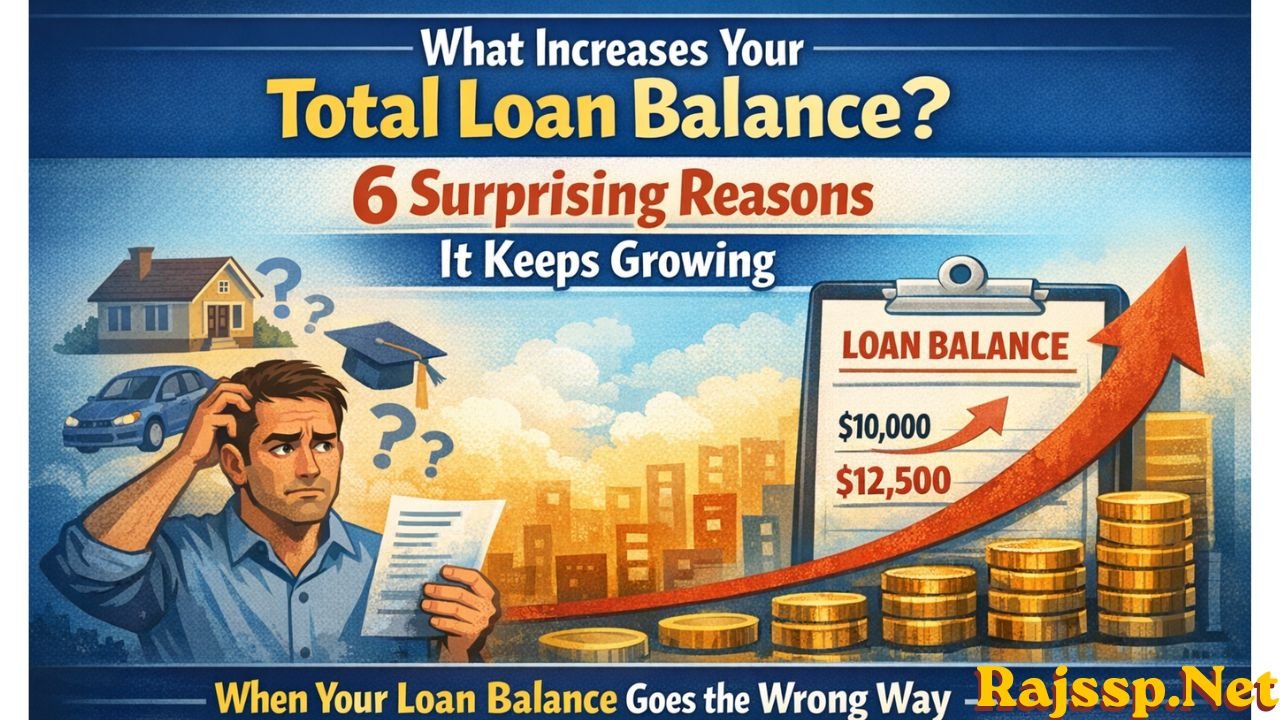
What Increases Your Total Loan Balance? 6 Surprising Reasons It Keeps Growing
Introduction: The Balance That Goes Wrong Way
Most people expect a loan balance to go in one direction — down. They make their payments on time, check their account a few months later, and feel a quiet sense of progress. So when that balance is higher than it was before, the reaction is usually confusion, frustration, or flat-out disbelief.
Here’s the thing: a rising loan balance isn’t always a sign that something went wrong. Sometimes it’s baked right into the structure of the loan itself. Understanding what increases your total loan balance is one of the most practical things a borrower can do — because once someone knows the mechanics, they can actually do something about it.
This article breaks down every major factor that causes a loan balance to grow over time. Whether someone is dealing with a student loan, a mortgage, an auto loan, or a credit card, the same handful of culprits tend to show up again and again.
1. Interest Accrual — The Primary Driver
How Interest Gets Calculated Every Single Day
Interest doesn’t wait for a monthly statement to pile up. For most loans, interest accrues daily, based on the current outstanding principal. The formula is straightforward: the lender takes the annual interest rate, divides it by 365, and multiplies that by the principal balance. That result — the daily interest charge — quietly gets added to what’s owed every single day.
It seems harmless on a day-to-day basis. But over months and years, it adds up fast.
Simple vs. Compound Interest
Not all interest works the same way. Simple interest is calculated only on the original principal. If someone borrows $10,000 at 7% simple interest, they’re charged $700 per year — always based on that original amount.
Compound interest is a different story. Here, interest gets charged on the principal and on any interest that has already accumulated. That compounding effect is what makes balances grow so aggressively when payments fall short — and it’s a key reason why compound interest is the mechanism behind so many runaway debt situations.
APR vs. the Real Cost Over Time
The Annual Percentage Rate (APR) is the number lenders are required to disclose, but it doesn’t always tell the full story. A 7% APR sounds manageable on paper. Stretched over 10 or 20 years without aggressive repayment, that same rate can mean paying tens of thousands of dollars beyond the original loan amount.
A Real Example: $10,000 at 7% With No Payments
Say someone takes out a $10,000 loan at 7% annual interest and makes zero payments for one year. At the end of that year, they don’t owe $10,700 — they owe more, because interest that isn’t paid gets added to the running balance, and then more interest accrues on top of that growing amount. By month 12, the balance has quietly climbed well past the original $10,000. That’s before any fees or penalties enter the picture.
2. Negative Amortization — When Payments Aren’t Enough
What Negative Amortization Actually Means
Negative amortization sounds technical, but the concept is simple: it happens when a borrower’s monthly payment is less than the interest being charged that month. Instead of shrinking the balance, the payment doesn’t even cover the interest — so the unpaid interest gets added directly to the principal.
The result is a loan balance that grows even when someone is making regular payments. This is one of the most counterintuitive things in personal finance, and it catches a lot of borrowers completely off guard.
Income-Driven Repayment Plans for Student Loans
For federal student loan borrowers on income-driven repayment (IDR) plans, negative amortization is a very real possibility. These plans — like SAVE, IBR, or PAYE — set monthly payments as a percentage of the borrower’s discretionary income. If that income is low, the payment might not be enough to cover the interest accruing each month.
This is a major reason why what increases your total student loan balance isn’t always about careless borrowing — it can happen even to people who are doing everything “right” by their repayment plan’s terms.
The Credit Card Minimum Payment Trap
Credit cards are perhaps the most common example of negative amortization in everyday life. When someone carries a balance and makes only the minimum monthly payment, a large portion of that payment goes straight to interest. Very little — sometimes almost nothing — reduces the actual principal. The balance stays stubbornly high, or even climbs month after month.
This is exactly why a $3,000 credit card balance can take a decade or more to pay off when only minimums are being paid.
Adjustable-Rate Mortgages With Payment Caps
Some adjustable-rate mortgages (ARMs) include payment caps that limit how much a monthly payment can increase, even if interest rates rise. If rates jump significantly, a borrower’s capped payment might no longer cover the new interest amount. The shortfall gets tacked onto the loan balance — and the borrower ends up owing more on their home than when they started.
3. Capitalized Interest — Lump-Sum Additions to the Principal
What Capitalization Means and When It Happens
Capitalization is what happens when unpaid, accrued interest gets officially added to the loan’s principal balance. From that point forward, the lender charges interest on the new, higher principal — which means the borrower is now paying interest on their interest.
This is one of the most important — and least talked about — answers to what increase your total loan balance. Capitalization often happens quietly, at specific trigger points in the life of a loan.
Deferment and Forbearance: Interest Still Accrues
Many borrowers use deferment or forbearance when they’re struggling to make payments. These programs pause or reduce monthly payments temporarily, which can feel like a relief. But on most unsubsidized federal loans and virtually all private loans, interest keeps accruing during that pause.
When the deferment or forbearance period ends, all that accumulated interest capitalizes — it gets rolled into the principal balance. Suddenly, the borrower is starting their repayment period with a much higher number than what they originally borrowed.
Grace Period End, Refinancing, and Repayment Plan Changes
For student loan borrowers specifically, capitalization can be triggered by several life events: the end of the post-graduation grace period, switching repayment plans, consolidating loans, or refinancing. Anyone asking about what increases your total loan balance FAFSA-funded student debt should pay close attention here — federal loans disbursed through FAFSA are particularly subject to capitalization events when borrowers transition between repayment stages.
Federal vs. Private Student Loan Capitalization Rules
Federal student loans have some built-in protections around capitalization. Under certain IDR plans, the government limits when and how interest can capitalize. Private loans, on the other hand, typically capitalize interest more frequently and with fewer restrictions — sometimes monthly, which dramatically accelerates balance growth.
4. Fees and Penalties Added to the Balance
Late Payment Fees
Missing a payment deadline doesn’t just hurt a credit score — it often triggers a late fee that gets added to the loan balance. On large loans, these fees can be significant, and if they’re not paid off quickly, interest starts accruing on those fees too.
Origination Fees Financed Into the Principal
Many loans — including federal student loans and personal loans — come with origination fees. These fees are sometimes deducted upfront from the disbursed amount, but in other cases they’re added directly to the loan principal. A borrower who takes out $10,000 might actually owe $10,400 on day one due to a 4% origination fee. That extra $400 starts accruing interest immediately.
NSF and Returned Payment Fees
If a scheduled loan payment bounces due to insufficient funds, lenders typically charge a returned payment or NSF (non-sufficient funds) fee. Like late fees, these charges can be added to the outstanding balance — and they can also trigger a late fee on top of everything else.
Prepayment Penalties
Some loan agreements include prepayment penalties — fees charged when a borrower pays off a loan ahead of schedule. These are less common today than they once were, but they still exist in certain mortgage and personal loan products. While a prepayment penalty doesn’t increase the balance directly in the traditional sense, it does increase the total cost of the loan and can make early payoff strategies less financially effective.
5. Comparison: Which Factors Affect Which Loan Types
Different loans are vulnerable to different balance-growing factors. Here’s a quick breakdown:
| Factor | Student Loans | Mortgage | Auto Loan | Credit Card |
|---|---|---|---|---|
| Interest accrual | ✓ | ✓ | ✓ | ✓ |
| Negative amortization | ✓ (IDR plans) | ✓ (some ARMs) | Rare | ✓ (minimums) |
| Capitalized interest | ✓ (major risk) | Sometimes | Rare | Sometimes |
| Late fees | ✓ | ✓ | ✓ | ✓ |
| Origination fees | ✓ | ✓ | Sometimes | Rare |
| Forbearance/deferment growth | ✓ | ✓ | Sometimes | N/A |
6. How to Stop the Balance From Growing
Pay at Least the Interest Each Month
The single most effective way to prevent a balance from ballooning is to make sure monthly payments cover at least the interest being charged. Even during periods of financial strain, paying just the interest prevents it from capitalizing and keeps the principal from growing.
Avoid Unnecessary Deferment or Forbearance
Deferment and forbearance are genuinely useful tools in a real financial emergency — but they shouldn’t be used as a first resort. Every month of paused payments is typically a month of accruing interest that will eventually capitalize. Borrowers who can afford even partial payments are usually better off making them.
Make Extra Principal Payments When Possible
When there’s room in the budget, directing extra money toward the principal is one of the most powerful moves a borrower can make. Paying down principal reduces the base on which interest is calculated — which means less interest accrues the following month, and so on. It creates a positive snowball effect that works in the opposite direction from capitalization.
Refinance for a Lower Rate or Better Terms
Refinancing to a lower interest rate can significantly reduce the amount of interest accruing each month, making it much easier for payments to actually reduce the principal. That said, refinancing federal student loans into private loans means losing access to income-driven repayment plans and federal forgiveness programs — a tradeoff worth understanding carefully before making a move.
FAQ: Quick Answers to Common Questions
Does deferment increase my loan balance?
Yes, in most cases. While deferment pauses required payments, interest typically keeps accruing on unsubsidized loans. When the deferment period ends, that interest usually capitalizes, adding to the principal.
What increases your total loan balance on income-driven repayment?
If the monthly payment under an IDR plan is less than the monthly interest charge, the unpaid interest may accrue and eventually capitalize. This is negative amortization in action.
I’ve seen “what increases your total loan balance quizlet” — is that a good study resource?
Quizlet flashcard sets can be a helpful study tool for understanding loan terminology and concepts, but they’re best used as a supplement to understanding the actual mechanics — not a replacement. The nuances of capitalization, amortization, and fee structures are worth learning in full.
Does forbearance increase my student loan balance?
Yes. Just like deferment, forbearance on most loans allows interest to accrue even while payments are paused. That interest can then capitalize when the forbearance ends, increasing the total principal balance.
What’s the fastest way to stop a loan balance from growing?
Pay more than the minimum every month, starting with covering at least the monthly interest charge. From there, any extra payment goes directly toward reducing the principal — which slows interest accrual going forward.
Final Thoughts
Understanding what increases your total loan balance is genuinely empowering. Once someone sees the mechanics clearly — how interest compounds, how capitalization works, how minimum payments can leave a balance virtually unchanged — they’re in a much stronger position to make decisions that actually move the needle.
None of this requires a finance degree. It just requires knowing which questions to ask, and now that the answers are on the table, the next step is putting them to work.
Also Read: PNC Student Loans: Complete Guide [2026]