Debt Consolidation Loan in India: The Complete Guide (2026)
Managing multiple loan payments every month can feel overwhelming. Between credit card bills, personal loans, and EMIs, it is easy to lose track — and even easier to fall behind. That is exactly where a debt consolidation loan steps in as a practical financial solution for millions of borrowers across India.
This guide breaks everything down in simple terms — what it is, how it works, who qualifies, which lenders offer it, and how to apply online — so anyone can make a well-informed decision before taking the next step.
What Is a Debt Consolidation Loan?
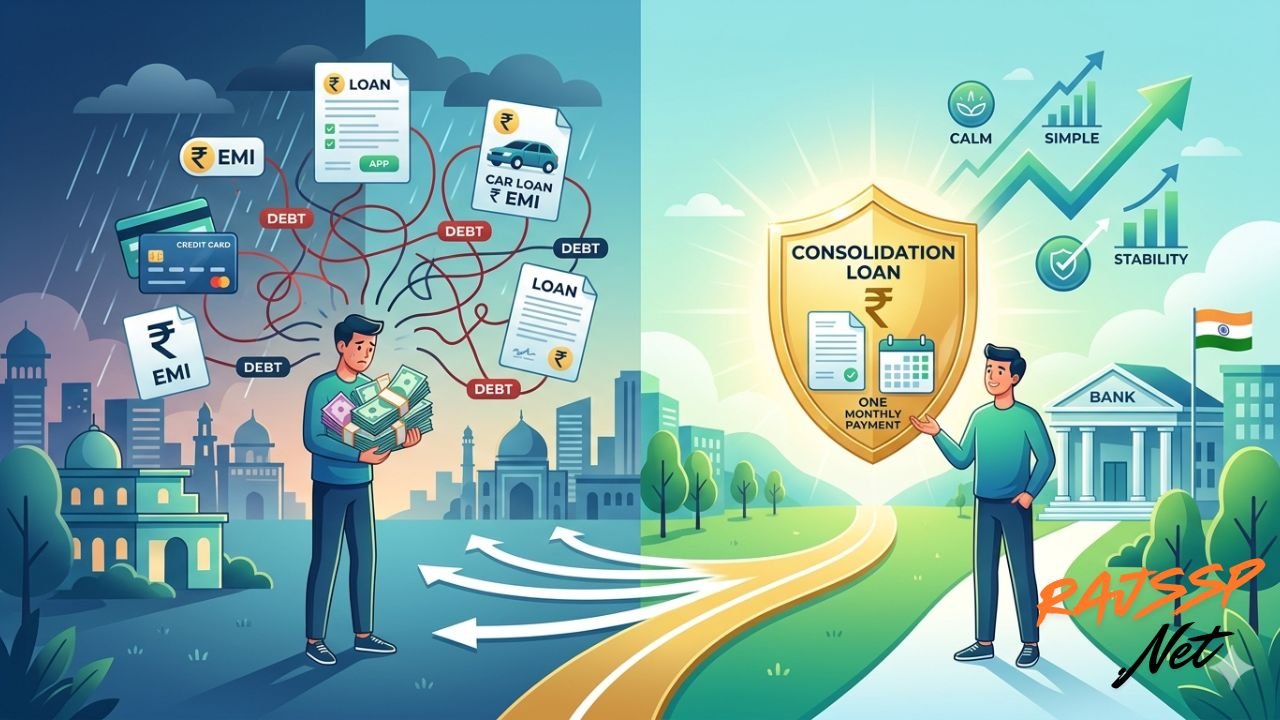
A debt consolidation loan is a personal loan that allows a borrower to combine multiple existing debts — such as credit card balances, personal loans, consumer durable loans, or medical bills — into a single loan. Instead of managing three, four, or even five different EMIs each month, the borrower makes a single monthly payment to a single lender.
The core idea is straightforward: take out a new loan at a lower interest rate, use those funds to pay off all existing debts, and then repay the new loan with a single EMI. The result is less financial stress, better cash flow management, and a cleaner repayment structure.
Think of it this way — if someone is paying 36% APR on a credit card, 22% on one personal loan, and 18% on another, consolidating all three into a single loan at 14% interest saves a meaningful amount of money over time.
How Does a Debt Consolidation Loan Work?
The process is fairly simple once a borrower understands the steps involved:
Step 1 — List All Existing Debts The borrower should start by making a complete list of all outstanding debts — including the lender name, outstanding balance, interest rate, and monthly EMI for each.
Step 2 — Check Eligibility and Credit Score Before applying, it is important to check the credit score (CIBIL score in India). Most lenders require a score of 700 or above for a competitive interest rate.
Step 3 — Compare Lenders and Loan Offers This is where research pays off. Comparing interest rates, processing fees, loan tenure, and prepayment charges across multiple lenders helps in finding the best deal.
Step 4 — Apply and Get Pre-Approved Many lenders in India now offer instant pre-approval checks that do not impact the credit score. This is a smart first move before submitting a formal application.
Step 5 — Receive Funds and Pay Off All Debts Once the loan is approved and disbursed, the borrower uses those funds to immediately clear all existing debts. This is a critical step — the whole point of consolidation is defeated if the old accounts are not closed.
Step 6 — Repay the New Loan via a Single EMI The borrower then repays the new consolidated loan through one fixed monthly EMI, ideally through autopay to avoid missing any payment.
Debt Consolidation Loans in India — An Overview
Debt consolidation loans in India are primarily offered in the form of personal loans by banks, NBFCs (Non-Banking Financial Companies), and fintech lenders. Unlike western markets where dedicated “debt consolidation products” are marketed separately, in India the product is largely categorised under the umbrella of personal loans used for debt repayment purposes.
The Indian lending market has grown significantly in recent years, and borrowers today have access to a wide range of options — from traditional public sector banks to digital-first fintech platforms that process applications entirely online.
Here is a quick overview of how the debt consolidation landscape looks in India:
| Feature | Details |
|---|---|
| Loan Type | Unsecured Personal Loan |
| Loan Amount | ₹50,000 – ₹40,00,000 |
| Interest Rate | 10.5% – 24% p.a. (varies by lender & profile) |
| Loan Tenure | 12 – 60 months |
| Processing Fee | 0.5% – 3% of loan amount |
| Prepayment Charges | Nil to 5% (varies by lender) |
| Disbursement Time | 24 hours – 7 business days |
The key advantage of using debt consolidation loans in India is the growing competition among lenders, which keeps interest rates relatively competitive for borrowers with a healthy credit profile.
Pros and Cons of a Debt Consolidation Loan
Before jumping in, it is worth looking at both sides of the coin. A debt consolidation loan is genuinely helpful in the right situation — but it is not a one-size-fits-all solution.
The Benefits
Single Monthly Payment Instead of tracking multiple due dates and payment amounts, the borrower deals with just one EMI. This alone reduces the risk of missing a payment.
Potential Interest Savings If the consolidation loan carries a lower interest rate than the existing debts — especially high-interest credit card debt — the borrower can save a significant amount over the repayment period.
Fixed Repayment Timeline Unlike a revolving credit card balance that can linger for years, a consolidation loan comes with a defined end date. This gives borrowers a clear light at the end of the tunnel.
Positive Impact on Credit Score Paying off multiple revolving credit accounts reduces the overall credit utilisation ratio, which can gradually improve the CIBIL score over time.
Reduced Financial Stress There is a real psychological benefit to simplifying finances. Managing one loan instead of many gives borrowers a greater sense of control.
The Drawbacks
Requires a Decent Credit Score Borrowers with a low CIBIL score may not qualify for a low enough interest rate to make consolidation worthwhile — or may not qualify at all.
Risk of Accumulating New Debt If the underlying spending habits do not change, a borrower may end up running up the credit card balances again after consolidating — doubling the debt problem.
Processing Fees and Other Charges Origination fees, GST on processing charges, and prepayment penalties on existing loans can eat into the expected savings.
Longer Tenure May Cost More Overall Stretching repayment over a longer period lowers the monthly EMI but increases the total interest paid over the life of the loan. The maths needs to add up before committing.
Types of Debt Consolidation Options Available in India
There is more than one way to consolidate debt in India. Here are the most commonly used approaches:
1. Personal Loan for Debt Consolidation
This is the most popular and accessible option. A borrower takes a new personal loan from a bank or NBFC and uses the disbursed amount to pay off all existing debts. No collateral is required for unsecured personal loans.
2. Balance Transfer on Credit Cards
Some credit card issuers offer a balance transfer facility, where the outstanding balance on one or more cards is transferred to a new card offering a lower or zero-percent introductory interest rate. This works well for credit card debt specifically.
3. Top-Up Loan on Existing Home Loan
Existing home loan borrowers can apply for a top-up loan from their lender at a relatively lower interest rate (since the home serves as collateral). This is one of the cheapest consolidation options available to eligible homeowners.
4. Loan Against Property (LAP)
For those who own property, a Loan Against Property can be used to clear multiple high-interest unsecured debts. The interest rates on LAP are significantly lower than personal loans, but the property is at risk if repayments are missed.
5. Gold Loan
In India, gold loans are a quick and accessible way to raise funds at a low interest rate. For borrowers with gold assets, this can be an effective short-term consolidation tool.
Debt Consolidation Loans Eligibility — Who Can Apply?
Understanding debt consolidation loans eligibility is a critical step before applying. Lenders in India evaluate multiple factors when processing an application. Here is what most lenders typically look for:
Age
Most lenders require applicants to be between 21 and 60 years of age. Some private sector banks extend this to 65 years for self-employed individuals.
Employment Status
Both salaried employees and self-employed individuals are eligible. Salaried applicants are generally viewed as lower risk due to a fixed income.
Minimum Income
For salaried applicants, a minimum monthly income of ₹15,000 – ₹25,000 is typically required, depending on the city and lender. For self-employed applicants, lenders look at annual turnover and ITR filings.
CIBIL Score
A CIBIL score of 700 or above is generally considered good for loan approval at a competitive interest rate. Scores below 650 may result in rejection or a significantly higher interest rate.
Work Experience
Salaried applicants typically need a minimum of 1–2 years of total work experience, with at least 6 months at the current employer. Self-employed applicants generally need to show 2–3 years of business continuity.
Existing Debt-to-Income (DTI) Ratio
Lenders assess how much of the applicant’s monthly income is already committed to debt repayment. A DTI ratio below 40–50% is generally preferred.
Documents Required
- PAN card and Aadhaar card
- Latest 3–6 months’ salary slips (for salaried)
- Last 6 months’ bank statements
- Form 16 or ITR for the last 2 years
- Proof of address (utility bill, passport, etc.)
Meeting the debt consolidation loans eligibility criteria increases the chances of approval significantly and helps in securing a better interest rate.
Which Banks Offer Debt Consolidation Loans in India?
One of the most common questions borrowers ask is: which banks offer debt consolidation loans in India? The answer is — many of them do, though it is marketed under personal loans for debt repayment rather than a standalone product name.
Here is an overview of the major lenders:
Public Sector Banks
State Bank of India (SBI) SBI offers personal loans that can be used for debt consolidation. With its wide branch network and relatively competitive interest rates starting from around 11% p.a., it is a popular choice among salaried government employees.
Bank of Baroda Bank of Baroda’s personal loan product can be used for debt consolidation purposes. The bank offers reasonable interest rates and a straightforward application process.
Punjab National Bank (PNB) PNB offers personal loans to salaried individuals and pensioners that work well for debt consolidation needs.
Private Sector Banks
HDFC Bank HDFC Bank is one of the most popular choices for personal loans in India. It offers quick disbursement, competitive rates, and a fully digital application experience for existing customers.
ICICI Bank ICICI Bank offers pre-approved personal loans to eligible customers with near-instant disbursement. The bank also provides a transparent online rate comparison tool.
Axis Bank Axis Bank’s personal loan product comes with flexible tenure options and a fully digital application process, making it a strong contender for debt consolidation needs.
Kotak Mahindra Bank Known for competitive interest rates, Kotak Mahindra Bank offers personal loans that are well suited for borrowers looking to consolidate high-interest debt.
NBFCs and Fintech Lenders
Bajaj Finserv Bajaj Finserv is one of the largest NBFC lenders in India and offers personal loans up to ₹40 lakh with quick processing and minimal documentation.
Tata Capital Tata Capital offers personal loans with flexible repayment options and transparent pricing — a reliable choice for debt consolidation.
MoneyTap, KreditBee, and Navi These fintech platforms cater to borrowers who need faster approvals, particularly for smaller loan amounts. They are worth exploring when time is a factor.
Note: Interest rates and eligibility criteria change frequently. It is always recommended to visit the official website of the respective lender or consult a certified financial advisor before applying.
Online Debt Consolidation Loans — The Faster, Smarter Way to Apply
The rise of digital banking and fintech in India has made online debt consolidation loans more accessible than ever before. Borrowers no longer need to visit a bank branch, carry stacks of physical documents, or wait weeks for approval.
Here is why applying for online debt consolidation loans has become the preferred route for many Indian borrowers:
Convenience
The entire process — from checking eligibility to submitting documents to receiving the disbursement — can be completed from a smartphone or laptop. Most lenders offer a 100% paperless process for existing customers.
Speed
Online personal loan applications are processed significantly faster than offline applications. Many lenders offer same-day or next-day disbursement for pre-approved customers.
Easy Comparison
Online loan aggregator platforms such as BankBazaar, PaisaBazaar, and Loanbaba allow borrowers to compare interest rates, processing fees, and tenure options from multiple lenders in one place — saving both time and money.
Soft Credit Checks
Most online platforms allow borrowers to check their eligibility and get an estimated rate offer through a soft credit inquiry — which does not affect the CIBIL score.
How to Apply for Online Debt Consolidation Loans
- Visit the official website or app of a chosen lender or aggregator platform
- Enter basic personal and financial details
- Check pre-approved or pre-qualified offers
- Upload KYC documents digitally (Aadhaar, PAN, bank statements)
- Review the loan offer — interest rate, EMI, tenure, and fees
- Accept the offer and receive disbursement directly to the bank account
- Use the funds to close all existing debts immediately
Effect on CIBIL Score — What Borrowers Should Know
A common concern among applicants is whether applying for a debt consolidation loan will hurt their credit score. Here is an honest breakdown:
Short-Term Impact (Minor Dip) When a borrower submits a formal loan application, the lender conducts a hard credit inquiry. This may cause a minor, temporary dip of 5–10 points in the CIBIL score.
Medium to Long-Term Benefit Once the consolidation loan is disbursed and the existing debts are paid off, the credit utilisation ratio drops — which is a positive signal for the credit score. Consistent on-time payments on the new loan further build credit health over time.
The net effect, for most responsible borrowers, is a gradual improvement in credit score over 6–12 months after consolidation.
Is a Debt Consolidation Loan the Right Move?
It makes a lot of sense in the right circumstances — but it is not for everyone. Here is a quick way to assess:
A debt consolidation loan is likely a smart move if:
- The borrower is managing 3 or more high-interest debts simultaneously
- The new consolidation loan offers a meaningfully lower interest rate
- The borrower has a stable income and a CIBIL score above 700
- Monthly cash flow is tight due to multiple EMI obligations
It may not be the best option if:
- The total debt amount is small and manageable
- The borrower’s CIBIL score is too low to qualify for a lower rate
- There is a risk of accumulating new debt after consolidation
- The fees and charges outweigh the interest savings
For those who do not qualify or prefer a non-loan approach, alternatives like a Debt Management Plan (DMP) through a credit counselling agency, the snowball or avalanche repayment method, or negotiating directly with lenders for revised repayment terms are worth exploring.
Frequently Asked Questions (FAQ)
What credit score is needed for a debt consolidation loan in India?
Most lenders in India prefer a CIBIL score of 700 or above. Some NBFCs and fintech lenders may approve applications with scores in the 650–699 range, but at higher interest rates.
How much can someone borrow through a debt consolidation loan?
Loan amounts typically range from ₹50,000 to ₹40,00,000 depending on the lender, the applicant’s income, and credit profile.
Does a debt consolidation loan hurt the credit score?
There may be a small, temporary dip due to the hard inquiry at the time of application. Over time, responsible repayment tends to improve the credit score.
Which banks offer debt consolidation loans in India?
Major lenders including SBI, HDFC Bank, ICICI Bank, Axis Bank, Kotak Mahindra Bank, Bajaj Finserv, and Tata Capital all offer personal loans that can effectively serve as debt consolidation loans.
How long does it take to get a debt consolidation loan in India?
With online applications, pre-approved customers can receive disbursement within 24 hours. For new customers, the process typically takes 2–5 business days.
Is debt consolidation the same as debt settlement?
No. Debt consolidation combines debts into a new loan that is repaid in full. Debt settlement involves negotiating with creditors to accept a reduced amount — which negatively impacts the credit score.
Can student loans be consolidated with a personal loan in India?
Education loans from banks are typically not consolidated using personal loans due to their distinct nature and tax benefits. It is advisable to consult a financial advisor before making any such decision.
Conclusion
For anyone juggling multiple loan payments, a debt consolidation loan can be a genuinely powerful tool to regain financial control. It simplifies repayment, can lower the overall interest burden, and — when managed responsibly — improves long-term credit health.
The Indian market offers strong options, from trusted public sector banks to fast-moving fintech lenders. Understanding debt consolidation loans eligibility upfront, comparing lenders carefully, and exploring online debt consolidation loans through aggregator platforms are the smartest first steps a borrower can take.
The right loan, at the right rate, for the right reason — that is what makes debt consolidation work.
Also Read: 7 Days Loan App List (2026): Top Instant Loan Apps for Quick Cash