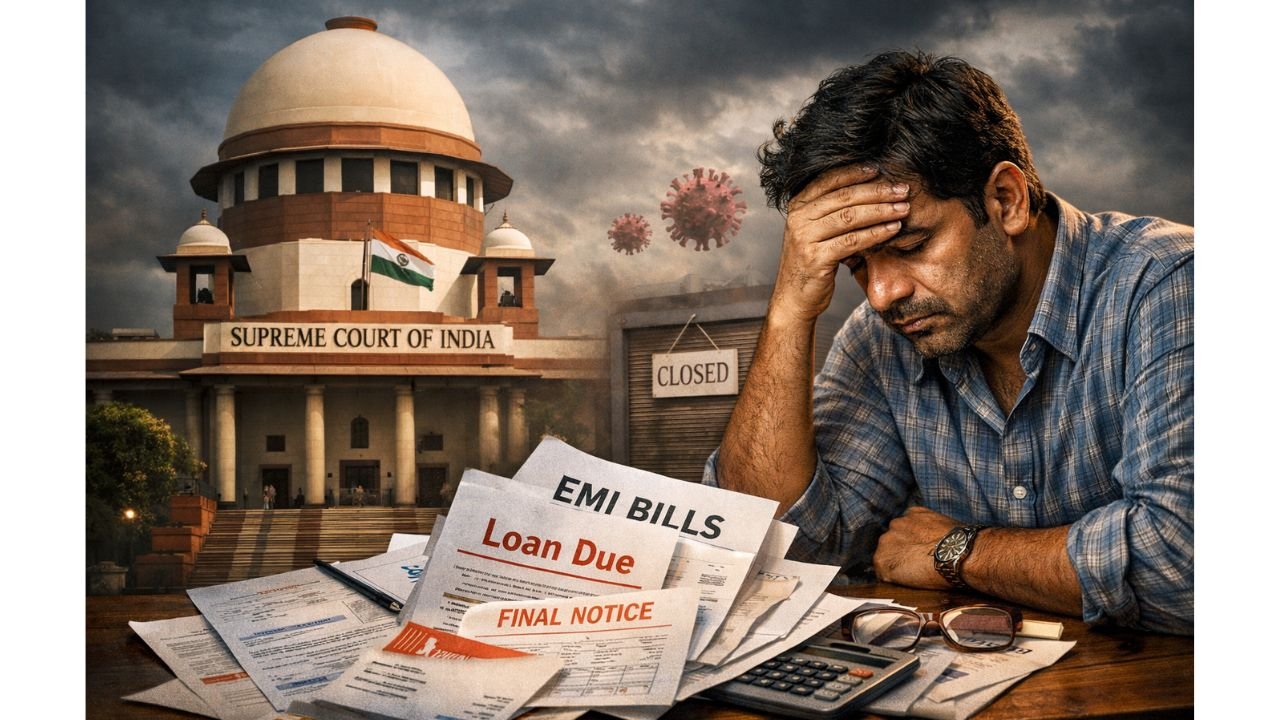
Loan Moratorium Interest Supreme Court: The Verdict That Changed Everything for Borrowers
Introduction: When Borrowers Needed a Lifeline Most
There are moments in legal history when the highest court of a country steps in and says — enough. The landmark verdict on loan moratorium interest from the Supreme Court of India was one such moment. When the COVID-19 pandemic swept across the nation in 2020, millions of borrowers — from small business owners to ordinary homeowners — found themselves in a financial storm they had never anticipated. EMIs kept accumulating, salaries froze, and businesses shuttered overnight.
A loan moratorium, simply put, is a temporary pause on loan repayments granted to borrowers during a period of financial stress. It allows borrowers to defer their EMI payments without being immediately penalised. But here’s the catch — deferring a payment doesn’t mean the interest stops running. And that one detail became the center of one of India’s most significant financial legal battles, ultimately decided by the Supreme Court of India.
This article walks through every key aspect of the loan moratorium interest Supreme Court case — from the RBI’s initial relief scheme to the final verdict and its ripple effects across India’s banking and borrower landscape.
Background: The RBI Loan Moratorium Scheme
How It All Started
On March 27, 2020, just days after a nationwide lockdown was declared, the Reserve Bank of India issued a circular announcing a three-month moratorium on loan installments. The relief window covered the period from March 1 to May 31, 2020, and was designed to give borrowers breathing room as the pandemic hammered household incomes and business revenues.
The response was immediate and massive — crores of Indians opted into the moratorium. As the pandemic showed no signs of retreating, the RBI extended the scheme for another three months, stretching the moratorium window all the way to August 31, 2020. For six months, borrowers were not required to make EMI payments on their term loans.
What the Moratorium Actually Meant
Here’s where things got complicated. The moratorium was a deferment — not a forgiveness. While borrowers were pausing their payments, interest continued to accumulate on the outstanding loan amount. For many borrowers, this meant that when the moratorium ended, they owed not just the regular interest but also interest on the unpaid interest — commonly called compound interest or interest on interest. In simple terms, opting for the moratorium wasn’t free. It came with a price tag that many borrowers hadn’t fully understood when they signed up.
This realization sparked outrage and eventually — a trip to the Supreme Court.
The Legal Battle: Petitions Before the Supreme Court
A Chorus of Grievances
The courtrooms of the Supreme Court of India don’t usually echo with the language of EMIs and loan accounts. But in 2020, that’s exactly what happened. More than 20 writ petitions were filed under Article 32 of the Constitution by a wide spectrum of associations — real estate developers through CREDAI, textile and knitwear industry groups, jewellery manufacturers, small businesses, and individual borrowers. They challenged the RBI’s notifications as being ultra vires — meaning beyond the authority granted by law — to the extent that they allowed interest to keep accruing during the moratorium.
What Borrowers Were Demanding
The petitioners weren’t shy about what they wanted. Their key demands included:
- A total waiver of all interest during the moratorium period
- A waiver of compound interest — the dreaded interest on interest
- An extension of the moratorium period beyond August 2020
- Sector-specific relief packages tailored to industries worst hit by the pandemic, such as real estate, aviation, and hospitality
As the case proceeded, the Supreme Court granted an important interim protection: loan accounts that had not been declared Non-Performing Assets (NPA) until August 31, 2020 were directed to not be classified as NPA until further orders. This was a significant short-term lifeline for businesses on the financial edge.
The Government and RBI’s Position: Why They Said No to Full Waiver
The ₹6 Lakh Crore Problem
The government’s stance was grounded in a stark financial reality. In its representation before the Supreme Court, the Central Government argued that granting a complete waiver of interest on all loans across all categories of borrowers would result in a loss exceeding ₹6 lakh crore. That staggering figure, the government said, would effectively wipe out a substantial portion of bank net worth, rendering most lenders financially unviable.
To illustrate the scale of the problem, the government pointed out that in the case of the State Bank of India alone — India’s largest bank — waiving six months of interest would completely destroy the bank’s net worth.
A Partial Concession
Facing mounting pressure, the Central Government on October 23, 2020 announced a partial relief policy — a decision not to charge interest on interest, but only for loans up to ₹2 crore and limited to eight specific loan categories. These included housing loans, education loans, personal loans to professionals, MSME loans, consumer durable loans, auto loans, credit card dues, and loans to farmers.
It was a measured step — but to many borrowers outside these categories or with higher loan amounts, it felt grossly insufficient. That discontent eventually found its way into the Supreme Court’s deliberations.
The Supreme Court Verdict: What Happened on March 23, 2021
The Case and the Bench
The verdict in Small Scale Industrial Manufacturers Association v. Union of India was delivered on March 23, 2021 by a three-judge bench comprising Justices Ashok Bhushan, R. Subhash Reddy, and MR Shah. The judgment was seen as a balanced, carefully calibrated ruling — one that gave some and withheld more.
What the Court Granted: The Big Win for Borrowers
In its most impactful ruling on loan moratorium interest, the Supreme Court held that no compound interest, interest on interest, or penal interest would be charged on any borrower who availed the moratorium, for the entire period of March 1 to August 31, 2020 — regardless of the size of the loan.
This was a huge departure from the government’s earlier position of capping relief at ₹2 crore. The court found no legal or rational basis for that cap and declared the government’s decision to limit relief to certain categories and loan amounts to be arbitrary and discriminatory.
Banks were further directed to refund or adjust any compound interest or penal interest already collected during the moratorium period. If a borrower had already paid such charges, the amount was to be credited toward their next installment. The estimated cost of this waiver — to be borne by the Government of India — was approximately ₹14,000 crore.
The bench also reasoned that the non-payment of installments during the moratorium could not be considered deliberate or willful default. Since compound interest is typically charged as a penalty for willful non-payment, applying it to moratorium borrowers was both unjust and illogical.
What the Court Refused: The Limits of Judicial Power
At the same time, the Supreme Court was equally clear about what it would not do. The court declined to:
- Extend the moratorium beyond August 31, 2020, calling it a policy decision that was not subject to judicial review
- Grant a total waiver of all interest during the moratorium, reasoning that banks must continue paying interest to depositors, pensioners, and welfare fund beneficiaries — all of whom depend on that income
- Order sector-specific relief packages beyond what had already been announced
- Extend the resolution mechanism invocation period or grant further reliefs above existing packages
The bench noted that banks pay interest to depositors only because borrowers pay interest to banks. Disturbing that cycle — by completely eliminating interest obligations — would threaten crores of small depositors and pensioners who survive on their interest income.
Key Legal Principles the Verdict Established
Beyond the immediate relief, the verdict laid down some enduring legal principles:
Judicial restraint in economic policy: The court affirmed that economic and financial policy decisions of the government are ordinarily not subject to judicial review unless they are proven to be malafide or arbitrary. Courts cannot direct governments or central banks to announce specific financial relief.
Compound interest as a penal charge: The verdict clarified that compound interest is by nature a penalty for willful default — and moratorium borrowers, by definition, were not willful defaulters. Charging compound interest on them was therefore unjustifiable.
Balancing stakeholder interests: The court’s approach factored in not just borrowers but also depositors, pensioners, and the banking system as a whole — emphasizing that judicial interventions in financial matters must account for systemic consequences.
Impact and Implications: Who Won, Who Lost, and What Changed
For Borrowers: A Meaningful, Though Partial, Victory
For millions of borrowers across India, the Supreme Court’s verdict on loan moratorium interest was genuinely meaningful. The removal of the ₹2 crore loan cap meant that even large borrowers — with home loans, business loans, or personal loans above that threshold — would receive the compound interest relief. Any overcharged amounts were to be refunded or adjusted, putting real money back in borrowers’ pockets.
It was not the complete interest waiver that many had hoped for. But it was a significant correction of what the court itself acknowledged was an arbitrary and discriminatory policy.
For Banks and Financial Institutions: A Short-Term Hit
The banking sector braced for a short-term financial impact following the verdict. Analysts anticipated that refunding or adjusting compound interest across millions of accounts would create a notable dent in bank revenues and reporting for the financial year 2020–21. The RBI subsequently issued a circular on April 7, 2021 directing all lending institutions — including commercial banks, cooperative banks, NBFCs, and housing finance companies — to take immediate steps to implement the refund and adjustment directive.
For RBI Policy: A Recalibration
From a regulatory standpoint, the verdict reinforced that a moratorium is a temporary crisis management tool — not a mechanism for permanent debt restructuring or interest waiver. Future RBI crisis packages will likely be designed with this in mind, perhaps building in more explicit relief provisions upfront to reduce the need for litigation.
Criticism and Analysis: Did the Court Go Far Enough?
The MSME and Small Borrower Question
Not everyone was satisfied. Small businesses and MSME owners — some of the hardest-hit segments — felt that the ruling, while helpful, did not go far enough. Many had taken loans well above ₹2 crore to fund their operations, and while the compound interest waiver now covered them, the continuation of base interest charges during the moratorium remained a burden.
Judicial Restraint in a Humanitarian Crisis
The verdict also reignited a long-standing debate in legal circles: how much should courts intervene in economic policy decisions during a humanitarian crisis? On one hand, pure policy deference can leave vulnerable populations without remedy when the government makes arbitrary decisions — and the court itself acknowledged the government’s ₹2 crore cap was arbitrary. On the other hand, the court correctly recognized that sweeping judicial orders on financial policy can have systemic consequences that go well beyond the courtroom.
The Arbitrariness Correction
Perhaps the most significant analytical takeaway from the verdict was the court’s willingness to call out and correct the arbitrary cap of ₹2 crore. This demonstrated that even within a framework of judicial restraint, the Supreme Court retains the authority — and the responsibility — to intervene when policy crosses into discrimination.
Conclusion: A Verdict That Balanced Competing Interests
The Supreme Court’s ruling on loan moratorium interest will be remembered as a nuanced, considered judgment in the middle of extraordinary economic distress. It gave borrowers real relief by eliminating compound and penal interest charges for the entire moratorium period — a benefit that extended to all loan sizes, not just the smallest ones. At the same time, it wisely stopped short of ordering a complete interest waiver that could have destabilized the very banks that millions of depositors and pensioners depend on.
The verdict also set a precedent that will matter far beyond the COVID era. It defined the limits of judicial review in financial policy, clarified when compounding is punitive versus contractual, and reminded both governments and courts that economic crises require responses that protect the many — not just the loudest voices in the courtroom.
For borrowers, banks, policymakers, and legal professionals alike, the story of the loan moratorium interest Supreme Court case is a masterclass in how law, economics, and human welfare intersect — and how the most difficult judicial decisions are rarely black and white.
Also Read: 7 Days Loan App List in India 2024 – Best Personal Loan Apps for Urgent Cash