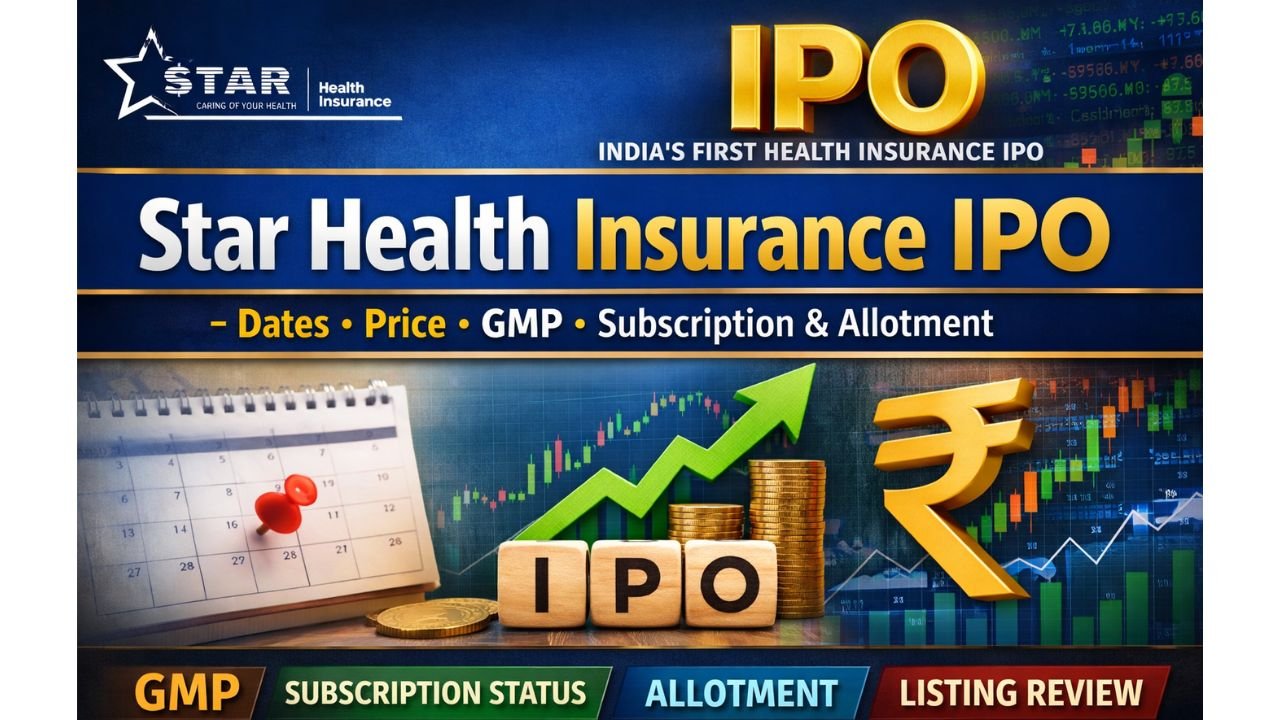
Star Health Insurance IPO: Dates, Price, GMP, Subscription Status, Allotment & Review
Introduction: A Historic IPO in India’s Health Insurance Sector
When Star Health and Allied Insurance Company stepped into the public markets, it wasn’t just another IPO — it was a landmark moment for India’s insurance landscape. The Star Health Insurance IPO marked the country’s first-ever listing of a pure-play, standalone health insurer, making it a talking point across investor communities, financial news platforms, and grey market circles alike.
Founded with the mission of making quality health coverage accessible to millions of Indians, Star Health grew from a regional insurer into the nation’s largest retail health insurance brand. So naturally, when the company decided to go public, retail investors, institutional heavyweights, and market watchers sat up and took notice.
This article covers everything one needs to know — from the Star Health Insurance IPO details like price, dates, and lot size, to the Star Health Insurance IPO GMP, subscription status, allotment date, listing price, and a balanced review of how the IPO actually performed.
Company Background: Who Is Star Health and Allied Insurance?
Star Health and Allied Insurance Company was established in 2006 as India’s first standalone health insurance (SAHI) company. Over the years, it scaled impressively, becoming the largest private health insurer and the largest retail health insurer in the country. By FY2021, the company held a 15.8% overall health insurance market share and a commanding 31.3% share in the retail health insurance segment, measured by Gross Written Premium (GWP).
The company’s gross written premium stood at ₹9,348.95 crore in FY2021, and its distribution network had expanded to 737 health insurance branches spread across 26 states and 4 Union Territories. With over 10,870 empanelled hospitals, Star Health had also built one of the largest health insurance hospital networks in India.
Star Health’s core product basket includes retail health insurance, group health insurance, personal accident coverage, and overseas travel insurance. Retail health and group health products together accounted for approximately 89.3% and 10.7% of total GWP respectively in FY2021.
Key Backers and Promoters
The company’s investor profile carried serious credibility. Westbridge Capital was a key backer, and the late Rakesh Jhunjhunwala — India’s legendary investor — held a significant stake, which brought tremendous retail interest in the Star Health and Allied Insurance IPO. Other promoter-linked entities included Safecrop Investments, Konark Trust, MMPL Trust, and Mio Star.
Star Health Insurance IPO Details: Dates, Price Band & Lot Size
Here’s a quick breakdown of the core Star Health Insurance IPO details that every investor tracked closely:
IPO Open Date: November 30, 2021 IPO Close Date: December 2, 2021 Star Health Insurance IPO Price Band: ₹870 – ₹900 per equity share Lot Size: Minimum 16 shares per application (minimum investment of ₹14,400 at the upper price band) Star Health Insurance IPO Listing Date: December 10, 2021 on BSE and NSE Star Health Insurance IPO Allotment Date: December 7–8, 2021 Employee Discount: ₹80 off the issue price for eligible employees Registrar: KFin Technologies Private Limited
The Star Health Insurance IPO date window of November 30 to December 2 gave investors a three-day window to submit their bids through ASBA or UPI-linked applications via brokers like Zerodha, Groww, Upstox, and others.
Star Health Insurance IPO Issue Size and Structure
The total Star Health Insurance IPO issue size was approximately ₹7,249 crore, comprising:
- Fresh Issue: ₹2,000 crore (proceeds to go directly to the company)
- Offer for Sale (OFS): Approximately 5.83 crore equity shares from existing shareholders
The OFS sellers included promoter-linked entities such as Safecrop Investments, Konark Trust, MMPL Trust, Apis Growth 6 Ltd, and Mio Star. This meant a significant portion of the proceeds went to existing shareholders rather than strengthening the company’s balance sheet directly.
Allocation Breakdown
- Qualified Institutional Buyers (QIBs): 75% of the net issue
- Non-Institutional Investors (NIIs): 15% of the net issue
- Retail Individual Investors (RIIs): 10% of the net issue
- Employee Reservation: Up to 1,12,592 shares at a discount
On November 29, 2021 (Anchor Investor day), the company raised ₹3,217.13 crore from 62 anchor investors at ₹900 per share. Notable anchor participants included Monetary Authority of Singapore, Abu Dhabi Investment Authority, Morgan Stanley, SBI Life Insurance, HDFC Life Insurance, and Max Life Insurance — a stellar line-up that initially boosted market confidence.
Use of IPO Proceeds
The fresh issue component of ₹2,000 crore was primarily aimed at augmenting the company’s capital base and improving its solvency levels — a critical metric for insurance companies regulated by IRDAI. The remaining proceeds were earmarked for general corporate purposes. Strengthening solvency ratios was especially important given the claims pressure the company had experienced during the COVID-19 pandemic.
Star Health Insurance IPO GMP (Grey Market Premium)
The Star Health Insurance IPO GMP (grey market premium) was one of the early indicators of investor sentiment, and the signals it sent were mixed.
In the days before the IPO opened, the Star Health Insurance IPO GMP today figures showed the premium had slipped from around ₹70 to approximately ₹30 — a decline of over 50%. Platforms tracking Star Health Insurance IPO GMP price data, including Star Health Insurance IPO GMP Ipowatch and Star Health Insurance IPO GMP Chanakya, reflected this cooling sentiment.
The star health insurance ipo grey market premium contraction was an early red flag that not all was well with retail enthusiasm, even if institutional interest remained steady. The Star Health Insurance IPO grey market buzz did continue right up to listing day, but it never recovered to the highs seen before the subscription window opened.
Star Health Insurance IPO GMP Price Today (at time of listing): Grey market was quoting a nominal or negative premium, suggesting a flat-to-weak listing.
Star Health Insurance IPO Subscription Status
The Star Health Insurance IPO subscription status told an interesting story. The overall IPO was subscribed approximately 0.79 times — meaning it did not receive full subscription across all categories.
Here’s a live-update summary of the Star Health Insurance IPO subscription status today as it closed:
- Retail Investor (RII) Category: 1.09x — just about fully subscribed
- Qualified Institutional Buyers (QIBs): 1.03x — marginally subscribed
- Non-Institutional Investors (NIIs): 0.19x — significantly undersubscribed
The Star Health Insurance IPO subscription numbers reflected a cautious mood in the market. The Star Health Insurance IPO subscription status live data showed that retail participation was the strongest category, while HNIs and large investors seemed unconvinced by the valuation at the upper end of the price band.
This underwhelming Star Health Insurance IPO subscription response was a notable event given the marquee backers and the company’s leadership position in its industry.
Star Health Insurance IPO Allotment Date & Allotment Status
Allotment Timeline
The Star Health Insurance IPO allotment date was finalized around December 7–8, 2021. Allotted shares were credited to demat accounts by December 9, 2021, a day before the listing.
How to Check Star Health Insurance IPO Allotment Status
Investors who applied could check their Star Health Insurance IPO allotment status through multiple channels:
Via BSE Website:
- Visit bseindia.com
- Select “Equity” and choose “Star Health” from the dropdown
- Enter application number and PAN card details
- Submit to view allotment
Via Registrar (KFin Technologies):
- Visit the KFin Technologies portal
- Select the Star Health IPO
- Enter PAN number, Application Number, or DP/Client ID
- Submit to check Star Health Insurance IPO allotment status check online
Via NSE:
- Go to nseindia.com’s IPO allotment section
- Select Star Health from the dropdown
- Enter credentials and click Search
Via Broker Apps (Groww, Zerodha, etc.): Most broker platforms allowed investors to check the Star Health Insurance IPO allotment status directly within the app under the IPO status section.
Since the IPO was subscribed below 1x overall, most retail investors who applied at the correct price band and with valid PAN/UPI details received full allotment — a rare silver lining for those who participated.
Star Health Insurance IPO Listing Price & Debut
The Star Health Insurance IPO listing date was December 10, 2021, when shares were listed simultaneously on BSE and NSE.
The Star Health Insurance IPO listing price was a disappointment for many investors. Despite the heavyweight anchor investor interest and strong company fundamentals, the stock made a weak debut — listing below or near the issue price of ₹900. The grey market had already hinted at this outcome through declining GMP figures in the days preceding the listing.
For those who had applied expecting strong listing gains, the Star Health Insurance IPO listing was a sobering reality check. The stock’s weak start underscored the importance of not relying solely on grey market data or brand recognition when evaluating IPO potential.
Star Health Insurance IPO Review: Business Strengths
Why Star Health Stood Out
Despite the mixed listing, Star Health’s business fundamentals remain worth examining in any honest Star Health Insurance IPO review.
The company grew its Gross Direct Premium at a 36% CAGR from FY16 to FY21 — nearly double the industry’s 18% growth rate during the same period. This consistent outperformance demonstrated operational strength and brand loyalty.
Its distribution network was another competitive moat. With over 4.6 lakh agents as of March 2021 — with individual agents contributing to 78.9% of GWP — Star Health had built a field force that was difficult for competitors to replicate overnight.
Star Health also had strong visibility on aggregator platforms like PolicyBazaar, which supported customer acquisition in the digital-first segment.
From a macro perspective, India’s health insurance industry was expected to grow at approximately 18% CAGR over the following four to five years, fueled by rising incomes, an aging population, increased health awareness post-COVID-19, and low existing penetration. India’s health insurance penetration stood at just 0.36% of GDP in 2019, compared to a global average of 2% — indicating massive untapped headroom.
Star Health Insurance IPO Valuation: Where Concerns Arose
Financial Performance Headwinds
The Star Health Insurance IPO valuation debate was central to why institutional and HNI participation was lukewarm. The company had reported losses in FY2021 and continued to post losses in the first half of FY2022, primarily due to a massive spike in COVID-19 related insurance claims.
This made the valuation a sticking point. Star Health was priced at a market cap-to-GWP ratio of approximately 5.53x — slightly higher than ICICI Lombard’s 5.21x, even though ICICI Lombard was a more diversified and profitable insurer. Analysts at the time noted the Star Health Insurance IPO valuation was on the expensive side, especially for a company reporting losses.
Several analysts advised long-term investors to wait for a 30% to 50% correction from the IPO price before entering the stock at a more comfortable valuation. For short-term investors hoping for listing day gains, the recommendation was largely to skip the IPO.
The Star Health Insurance IPO review from most independent analysts was neutral-to-cautious — acknowledging the company’s market leadership but flagging valuation concerns and near-term profitability challenges.
Star Health Insurance IPO on Chittorgarh & Other Tracking Platforms
Platforms like Star Health Insurance IPO Chittorgarh (chittorgarh.com) were among the most visited resources during the IPO period. Chittorgarh provided real-time tracking of:
- Star Health Insurance IPO subscription status live
- Star Health Insurance IPO GMP today
- Star Health Insurance IPO allotment status
- Lot size, price band, and issue timeline data
Investors relied on Chittorgarh alongside IPOWatch and Chanakya GMP platforms to monitor the Star Health Insurance IPO GMP movements right up to listing day. These platforms remain useful references for historical IPO data as well.
Risks and Challenges
No Star Health Insurance IPO review would be complete without a fair assessment of the risks:
1. High COVID-19 Claim Ratios: The pandemic exposed health insurers to unprecedented claim volumes. Star Health’s losses in FY21 and H1FY22 were a direct result of this — a risk that could recur in future health crises.
2. Competition: While Star Health is the market leader among standalone health insurers (SAHIs), it faces competition from multi-line players like ICICI Lombard and HDFC ERGO, who offer health insurance as part of a broader portfolio.
3. Regulatory Risk: The insurance sector in India is tightly regulated by IRDAI. Any changes in premium pricing guidelines, solvency requirements, or product norms can directly impact profitability.
4. Market Immaturity: Despite the large opportunity, India’s health insurance market is still nascent with low penetration, meaning customer awareness and willingness to pay remain ongoing challenges.
5. Valuation Overhang: The IPO pricing left little room for error. Investors who bought at the upper price band of ₹900 faced a painful wait before the stock recovered to meaningful gains.
Investor Takeaways and Lessons
The Star Health and Allied Insurance IPO offered some valuable lessons for Indian retail investors:
Brand Doesn’t Equal Listing Gain: Star Health is one of India’s most recognized health insurers. Yet the IPO underperformed on listing day — a reminder that brand strength alone doesn’t guarantee a profitable IPO investment.
GMP Is a Sentiment Indicator, Not a Guarantee: The Star Health Insurance IPO GMP declined sharply before the IPO opened. Investors who tracked the ipo star health insurance grey market data carefully had advance warning that listing gains were unlikely.
Subscription Data Matters: The poor NII subscription (0.19x) was a clear signal that sophisticated investors weren’t willing to pay the asking price. Retail investors should watch all category subscription data — not just the overall figure — when assessing an IPO.
Long-Term vs. Short-Term Lens: For investors who held on patiently and added at lower prices, Star Health eventually offered a better entry point. The business itself — with strong market leadership and a large runway — remains fundamentally sound despite the rocky IPO experience.
Conclusion: The Full Circle of the Star Health Insurance IPO Journey
The Star Health Insurance IPO was one of 2021’s most-watched listings, and for good reason. It brought India’s largest retail health insurer to the public markets for the first time, offered retail investors exposure to a high-growth sector, and attracted global institutional names as anchor investors.
Yet the ipo star health insurance journey also illustrated how even market-leading companies can underwhelm when valuation is stretched and near-term financials are under pressure. The Star Health Insurance IPO listing price, the weak Star Health Insurance IPO subscription status, and the declining gmp of star health insurance ipo were all consistent signals that the market wanted a better price.
Today, Star Health and Allied Insurance IPO remains an important case study for Indian IPO investors — a story of a genuinely strong business that came to market at a moment when short-term headwinds and rich valuation conspired to produce a disappointing debut.
For those still curious about the Star Health Insurance IPO allotment status, Star Health Insurance IPO status, or Star Health Insurance IPO review from a historical perspective, resources like Chittorgarh, IPO Watch, and KFin Technologies’ registrar portal continue to serve as reference points.
As India’s health insurance sector grows — and it will, given demographic tailwinds and rising awareness — Star Health is well-positioned to benefit. The IPO may have stumbled out of the gate, but the long-term story of the company it represents continues to unfold.
Also Read: Loan Moratorium Interest Supreme Court: The Verdict That Changed Everything for Borrowers