Salon Insurance: The Complete Guide to Protecting Your Beauty Business
Introduction
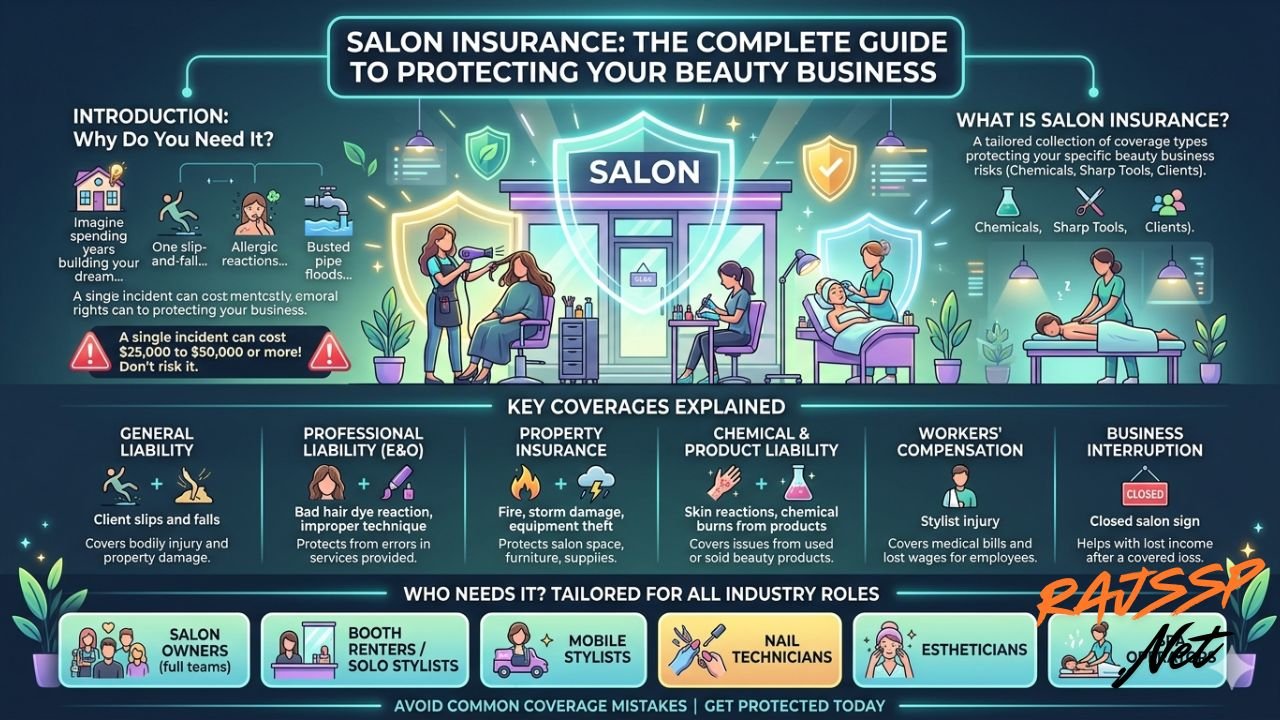
Imagine spending years building a thriving beauty business — the loyal clients, the perfectly curated space, the skilled team — only for a single incident to wipe it all out financially. One slip-and-fall in the waiting area, one allergic reaction to a hair dye, one busted pipe flooding the shop. Without the right salon insurance, any of these scenarios could result in claims costing $25,000 to $50,000 or more.
Salon insurance is not a one-size-fits-all product. It is a collection of coverage types that work together to protect a beauty business from the very specific, very real risks that come with working with chemicals, sharp tools, and the public every single day. A nail technician’s risks differ from a spa owner’s, and a solo booth renter has entirely different needs than a hair salon employing a team of 10 stylists.
This guide is written for everyone operating in the beauty industry — salon owners, booth renters, mobile stylists, nail techs, estheticians, and spa operators. By the end, readers will have a clear understanding of what beauty salon insurance covers, how much it costs, which policy fits their specific business, and how to avoid the most common coverage mistakes.
Why Salon Insurance Is Essential
The beauty industry might look glamorous from the outside, but behind the scenes, it carries a surprisingly high level of everyday risk. Chemical burns from hair color and relaxers, allergic reactions to lash glue or wax, a client slipping on a wet floor, scissors causing an accidental cut — these are not hypothetical disasters. They happen regularly in salons across the country.
The average liability claim in the beauty industry exceeds $5,000, and a single chemical hair burn incident can escalate to $25,000 or well over $100,000 once medical bills, legal fees, and settlement costs are factored in. Yet approximately 20 to 30 percent of beauty professionals currently operate without any form of insurance, leaving themselves dangerously exposed to financial ruin from a single bad day.
Beyond protecting against lawsuits, salon business insurance is often a non-negotiable requirement just to open the doors. Most commercial landlords require tenants to carry between $1 million and $2 million in general liability coverage before signing a lease. Franchise operators and commercial clients hold the same expectations. In other words, skipping beauty salon business insurance does not just put a business at legal risk — it can prevent a salon from operating at all.
The smartest salon owners treat insurance not as an expense, but as the foundation their entire business is built on.
Types of Salon Insurance Coverage
Understanding the landscape of salon and spa insurance means knowing what each coverage type actually does. Here is a breakdown of the most important policies every beauty professional should know.
General Liability Insurance
General liability is the bedrock of any hair salon business insurance package. It protects the business from third-party claims involving bodily injury, property damage, and personal injury. In practical terms, this is the coverage that kicks in if a client trips over a power cord in the styling area, slips on a freshly mopped floor, or has personal property damaged while on the premises.
General liability helps protect a salon from claims that it caused bodily injury or property damage to others — a straightforward but critical layer of protection for any business that welcomes the public through its doors.
Professional Liability Insurance (Errors & Omissions)
While general liability handles accidents on the premises, professional liability — also called Errors & Omissions (E&O) insurance — covers claims directly tied to the services being performed. This is where hair salon liability insurance becomes especially important.
If a client experiences an allergic reaction to a chemical treatment, suffers hair breakage from an incorrect coloring process, or claims a botched service caused them harm, professional liability is what steps in. As beauty services continue to expand into more advanced territory — lash extensions, micro-needling, keratin treatments, scalp procedures — the potential for professional liability claims grows alongside them.
Workers’ Compensation Insurance
Any hair salon insurance package for a salon with employees must include workers’ compensation. It is legally required in most U.S. states once the first employee is hired, though the specific threshold varies. States like New York and New Jersey require it starting from one employee, while Florida requires it once a salon reaches four employees.
Workers’ comp covers medical expenses, rehabilitation costs, and a portion of lost wages if an employee is injured on the job — whether from a chemical splash, a repetitive strain injury, or an accidental cut.
Commercial Property Insurance
A salon’s physical assets represent a significant investment. Chairs, styling stations, mirrors, washing units, color equipment, retail inventory, computers, and point-of-sale systems all add up quickly. Commercial property insurance protects these assets against fire, theft, vandalism, burst pipes, and certain natural disasters.
For salon owners who lease their space, this coverage protects their equipment and improvements — not the building itself, which is the landlord’s responsibility.
Business Owner’s Policy (BOP)
A Business Owner’s Policy bundles general liability, commercial property, and business interruption coverage into a single package, typically at a lower combined cost than purchasing each policy separately. For most small to mid-sized beauty businesses, a BOP is the most practical and cost-effective foundation for their beauty salons insurance strategy.
A BOP typically costs between $85 and $116 per month for salons and between $127 and $181 per month for spas — making it a smart starting point for salon and spa insurance coverage.
Business Interruption Insurance
If a covered event — say, a fire or flood — forces a salon to close temporarily, business interruption insurance replaces the lost income during the downtime. It can cover rent obligations, payroll, and operating costs while the business is being repaired or rebuilt. This coverage is often included in a BOP.
Product Liability Insurance
Salons sell products. They also use them. Product liability insurance covers claims that arise from a product sold or applied in the salon causing harm — for instance, a client experiencing a severe allergic reaction to a hair dye brand the salon carries. Even when the salon did not manufacture the product, it can still be named in a lawsuit.
How Much Does Salon Insurance Cost?
One of the most common questions around business insurance for a beauty salon is simply: what does it cost? The answer depends on several variables, but here is a general breakdown of average monthly premiums:
| Coverage Type | Average Monthly Cost |
|---|---|
| General Liability | $35 – $78/month |
| Professional Liability | $42 – $50/month |
| Workers’ Compensation | $13 – $17/month |
| BOP (Bundled) | $85 – $116/month |
Overall, salon insurance costs an average of $35 to $110 per month for many businesses, but the actual cost of any specific policy will vary based on the size of the operation, the services offered, and a number of other factors.
The key variables that influence pricing include:
- Location: Salons in high-cost urban areas or states with stricter regulations typically pay more.
- Number of employees: More staff means greater workers’ comp exposure.
- Services offered: Advanced treatments like chemical relaxers, laser services, or micro-needling carry higher risk profiles.
- Claims history: A clean record lowers premiums; prior claims push them up.
- Coverage limits: Higher limits mean better protection but higher monthly costs.
When shopping for a beauty salon insurance quote, it is always worth comparing multiple carriers rather than accepting the first offer.
Salon Insurance for Different Business Types
Not every beauty business has the same risk profile, and insurance for a beauty salon should reflect the specific nature of the operation.
Hair Salons
Hair salon insurance needs to address the unique risks of chemical services — color, bleach, relaxers, and keratin treatments. General liability and professional liability are essential, along with commercial property coverage to protect styling equipment and product inventory. Insurance for hair salons should also account for any retail sales and the number of stylists working under one roof.
Nail Salons
Nail salon insurance presents a distinct set of risks. Tool-related injuries, exposure to harsh chemical solvents, and the potential for fungal infection claims from shared equipment are all real concerns. Professional liability is especially critical here, as is product liability for the range of nail products used daily.
Med Spas and Esthetic Salons
Medical spas operate in a more complex regulatory environment. They face stricter requirements — including physician ownership mandates in many states — and typically need higher liability limits due to the medical and quasi-medical procedures involved. Salon and spa insurance for a med spa should be built with guidance from an agent who specializes in the medical aesthetics space.
Mobile Beauty Professionals
Mobile stylists, makeup artists, and estheticians who work across multiple locations face a coverage gap that standard policies often leave open. Insurance for a hair salon on wheels needs to follow the professional wherever they go, which means verifying that the policy does not restrict coverage to a single fixed address. Additional coverage for equipment in transit and commercial auto insurance may also be necessary.
Booth Renters and Independent Contractors
Booth renters occupy a tricky position in the insurance landscape. As a booth, suite, or chair renter, a beauty professional is essentially operating as their own small business within someone else’s space. Because they are not employees of the salon, the host salon’s policy does not extend to cover them.
Every booth renter needs their own hairdressing salon insurance or individual professional liability policy. In fact, many salons now require proof of coverage before allowing anyone to rent space — making this a business requirement, not just a precaution.
Legal Requirements by State
The legal landscape around hair salon business insurance varies significantly depending on where a salon operates.
Workers’ compensation is the most universally regulated coverage type, but the specific threshold for when it becomes mandatory differs from state to state. New York and New Jersey require it from the first employee, while other states allow salons to operate with a small team before coverage becomes legally required.
General liability insurance, while rarely mandated by law on its own, is almost universally required by commercial landlords, lenders, and franchisor agreements. For practical purposes, any salon operating in a leased space will need it regardless of whether the law technically demands it.
In California, for example, the requirements are among the strictest in the country. Salons with even part-time employees must carry workers’ comp, and certain city ordinances may impose additional insurance minimums. Any salon owner should verify their specific state and local requirements through their state’s Department of Labor or Insurance Commissioner before assuming their coverage is compliant.
How to Choose the Right Salon Insurance Policy
Finding the right hair salon insurance quotes starts with understanding the business’s specific risk profile. Here is a practical step-by-step approach:
- Assess services and risks. A salon doing only blowouts has different risk exposure than one offering chemical straightening, lash lifts, and scalp micro-pigmentation. Build coverage around the actual services being performed.
- Determine employee status. Even one part-time employee in most states triggers a workers’ comp requirement. Do not overlook this.
- Review landlord and franchisor requirements. Before finalizing any policy, check what coverage limits the lease or franchise agreement actually requires.
- Compare multiple quotes. When gathering hair salon insurance quotes, look beyond the monthly premium. A cheaper policy with major exclusions or low limits is not actually saving money — it is creating a false sense of security.
- Work with a specialist. An independent insurance agent with experience in the beauty industry will understand the nuances of beauty salon business insurance far better than a generalist.
- Revisit coverage annually. As the business grows — adding employees, expanding services, opening new locations — the policy needs to grow with it. Many salon owners discover they are dangerously underinsured simply because they never updated a policy they bought when they first opened.
Top Salon Insurance Providers (2026)
Several carriers have established strong reputations in the beauty industry space. Here is a brief look at some of the leading providers for beauty salon insurance:
- Coverdash — Currently one of the most affordable entry points, with general liability starting around $42 per month. A solid choice for solo operators and small salons shopping on budget without sacrificing core protection.
- The Hartford — A well-established carrier known for broad coverage options and strong customer service. Well-suited for established salon businesses looking for comprehensive salon business insurance packages.
- Simply Business — A marketplace-style platform that aggregates quotes from multiple insurers, making it easy to compare beauty salon insurance quotes in one place.
- Elite Beauty Society — A specialist insurer built specifically for beauty professionals, offering tailored packages for hairdressers, estheticians, nail techs, and mobile stylists.
- NEXT Insurance — A digital-first carrier that makes it easy to get insurance for a hair salon quickly, often with same-day coverage available.
The right provider will depend on the size of the operation, the services offered, and whether the priority is affordability, breadth of coverage, or specialist expertise in the beauty industry.
Common Mistakes Salon Owners Make With Insurance
Even well-intentioned salon owners sometimes find themselves dangerously underprotected because of avoidable missteps. Here are the most common ones:
Assuming the building owner’s policy covers them. It does not. A landlord’s property insurance covers the building structure — not the tenant’s equipment, inventory, or liability exposure.
Carrying only general liability and skipping professional liability. General liability will not cover a claim that stems from a service the salon performed. Professional liability is what protects against dissatisfied clients, chemical damage claims, and treatment-related injuries.
Treating booth renters as covered employees. Since booth renters are independent contractors, they fall outside the salon’s policy. Every renter needs their own hairdressing salon insurance policy.
Underinsuring equipment and inventory. Styling chairs, color systems, dryers, and retail stock represent thousands of dollars. If the replacement cost is not accurately reflected in the policy, any claim payout will fall short.
Failing to update coverage after adding new services. Adding laser hair removal or micro-needling to a menu without notifying the insurer can result in those claims being denied outright. Always inform the carrier when services change.
Frequently Asked Questions
Is salon insurance required by law?
Workers’ compensation is legally required in most states for salons with employees. General liability is typically required by landlords rather than by law, but it is effectively unavoidable for any salon operating in a commercial space.
Does salon insurance cover independent contractors?
No. The host salon’s salon business insurance policy does not extend to independent contractors or booth renters. Each contractor is responsible for carrying their own coverage.
What is the difference between general liability and professional liability?
General liability covers accidents that happen on the premises — a client slipping or personal property getting damaged. Professional liability covers claims that arise directly from the services performed, such as a chemical burn or a botched treatment.
How much coverage does a salon need?
Most landlords and clients require a minimum of $1 million per occurrence and $2 million aggregate. Salons offering higher-risk services or employing larger teams should consider higher limits.
Can a salon get same-day coverage?
Yes. Several providers — including NEXT Insurance and Coverdash — offer same-day beauty salon insurance binding, which is especially useful for booth renters or new salon owners who need proof of coverage quickly.
Conclusion
Running a beauty business is a labor of love, creativity, and serious hard work. Protecting it with the right salon insurance is one of the most responsible decisions an owner can make — not just for themselves, but for their clients, their team, and everyone who depends on the business staying open.
The beauty industry carries real, everyday risks. A single claim without proper beauty salon business insurance can undo years of work in an instant. But with the right combination of general liability, professional liability, workers’ compensation, and property coverage, salon owners can walk into work every day knowing that whatever happens, they are covered.
The next step is straightforward: gather beauty salon insurance quotes, compare options from at least two or three carriers, and consult with an independent agent who understands the beauty industry. The right policy is out there — and for most salons, it is far more affordable than the cost of going without it.
Ready to protect your salon? Get a free quote today, speak with a licensed beauty industry insurance specialist, or download a coverage checklist to make sure nothing falls through the cracks.
Also Read: Go Auto Insurance Review 2025: Is It the Right Low-Cost Option for You?